Electric Gate Opener Installation: A Step-by-Step Guide for Bradenton Properties
You have decided to add an electric gate opener to your property. Good call. For a commercial lot in Bradenton, a motorized gate is the piece that turns a fence from a suggestion into real security. However, the install only pays off if the gate, the opener, and the site all work together. This guide walks through the steps a solid installation follows, what the work includes, where owners get tripped up, and what you can handle yourself versus what belongs with a pro.
Most of the steps below apply whether you run a contractor yard, a self-storage facility, or a small retail plaza. Homeowners with an automatic driveway gate will recognize the same sequence, just at a smaller scale.
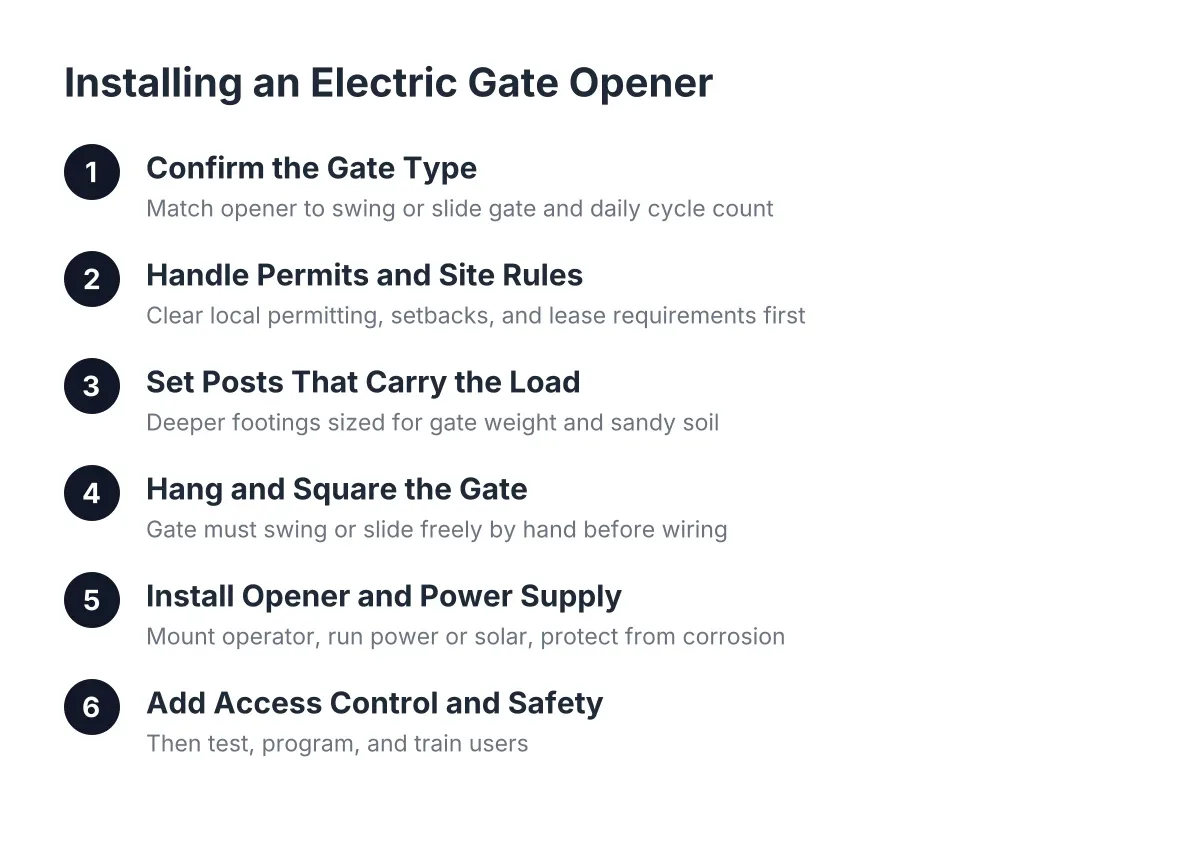
Step 1: Confirm the Gate Type Before You Pick an Opener
Match the opener to the gate, not the other way around. A swing gate and a sliding gate use different operator hardware, draw different amounts of power, and need different clearances. If your lot slopes toward the entrance or you have limited swing room near a drive aisle, a slide gate usually makes more sense. If you have flat ground and space behind the fence line, a swing gate can be simpler and cheaper to operate.
For commercial lots, also think about cycle count. An opener rated for a home that opens a few times a day will wear out fast on a storage facility gate that cycles dozens of times before lunch. Ask any installer to spec the operator for your actual daily traffic, not just the gate weight.
A few questions to settle at this step:
- How many times per day will the gate open and close?
- Does the entrance need to stay usable during business hours while work happens?
- Will vehicles be trucks and trailers, or mostly passenger cars?
- Do you need the gate to fail open or fail closed during a power outage?
That last one matters in Bradenton. Storm-season outages happen, and your answer changes which electric gate opener and backup setup fit the job.
Step 2: Handle Permits and Site Rules First
Gate installation in the Bradenton area usually runs through the local permitting office, and automatic gates add electrical and safety requirements on top of standard fence rules. Setbacks matter too. Low-lying lots and flood-zone parcels around Manatee County can carry placement restrictions that affect where posts and operator pads can go.
Commercial properties have an extra layer. Check your lease, your insurance policy, and any site plan requirements before the first hole gets dug. Suppose a property manager signs off on a slide gate, then learns the lease requires fire department access with a knox switch or emergency release. In that scenario, a retrofit costs more than doing it right the first time. A good installer will ask about these requirements up front; if a quote never mentions permits or safety devices, treat that as a red flag.
Step 3: Set Posts That Can Carry the Load
The posts do more work than the opener does. An automatic driveway gate puts constant, repeated stress on the hinge or guide posts, and Bradenton's sandy soil does not hold a post the way clay does. Expect the crew to dig deeper and wider footings than a standard fence post gets, with concrete sized for the gate weight plus the operator's pull.
Ground movement is the quiet killer here. Sandy, low-lying lots settle, and a gate that was square in March can drag by October. Experienced installers plan for that shift in how they set hardware and position latching points, so the gate keeps working as the ground moves instead of binding against it. On tight sites, such as a gate butting against an existing fence or squeezed near a tree line, a reinforced post with a steel core can solve problems a standard post cannot.
This step is also where string lines and layout matter. Posts set out of line by even a small amount will fight the operator every cycle and shorten its life.
Step 4: Hang and Square the Gate
Before the opener ever gets wired, the gate itself has to swing or slide freely by hand. A gate that binds manually will burn out a motor. Crews typically pre-fit the gate, check it for square, and set hinges or rollers so the leaf moves without dragging at any point in its travel.
Small details at this stage separate a gate that lasts from one that generates repair calls. For example, on vinyl gates, reinforcing the hinge-side frame makes the screw connections far stronger, since the hinge side takes the abuse while the latch side rarely fails. On any material, setting the latch point with room to adjust protects you when the ground settles. None of this shows up in a product photo, but it is where quality lives.
Step 5: Install the Electric Gate Opener and Power Supply
Now the opener goes in. The operator mounts to a concrete pad or post bracket, connects to the gate arm or chain, and ties into power. For most commercial lots, that means a dedicated electrical run from a nearby panel, often trenched underground to the gate location. Trenching distance is one of the bigger cost drivers on these jobs, so a gate close to existing power costs less to automate than one at the far corner of the lot.
A solar electric gate opener is an option where running power is impractical, and Bradenton sun supports it well. The trade-off is cycle capacity; solar setups suit lower-traffic gates better than a busy commercial entrance. If your gate cycles heavily all day, hardwired power with a battery backup is the safer spec.
Humidity and salt air are the other local factors. Enclosures, wiring connections, and hardware need to stand up to corrosion, or you will be searching "electric gate opener repair near me" within a couple of years. Ask what corrosion protection the quoted hardware carries.
Step 6: Add Access Control and Safety Devices
This is the step that makes the system useful for a business. Decide how people get in:
- Remotes for staff vehicles
- A keypad with codes you can change when employees leave
- A card reader or phone-based entry for tenants
- An intercom or call box for visitors and deliveries
- Vehicle loop detectors so the gate opens for exiting trucks automatically
Safety devices are not optional. Photo eyes and edge sensors stop the gate from closing on a vehicle or a person, and modern operators require entrapment protection to run correctly. A gate installed without proper safety sensors is a liability sitting at your entrance. If a low bid skips these, the bid is not actually lower; it is incomplete.
Step 7: Test, Program, and Train Your People
A professional install ends with a full test cycle. The installer programs open and close limits, sets the auto-close timer, verifies the sensors stop and reverse the gate, and tests the manual release for power outages. For a commercial site, make sure more than one person on your team knows how to release the gate manually and how to add or delete keypad codes.
Keep the manuals, write down the operator model, and store the programming instructions somewhere the next manager can find them. Staff turnover is real, and the gate outlasts most employees.
How Long Does Electric Gate Opener Installation Take?
For a straightforward site with the fence already in place, installing an electric gate opener on an existing gate often takes about a day. A full project, meaning new posts, a new gate, trenched power, and access control, commonly spreads across several days once concrete cure time is included. Permitting adds lead time before any work starts.
Timelines stretch when power has to be trenched a long distance, when the site needs reinforced posts, or when custom gates are fabricated. If downtime worries you, ask the installer to sequence the work so the entrance stays passable during business hours; most crews can stage it that way with notice.
What Does the Work Cost?
Cost depends on factors more than any single number, and anyone quoting a flat price before seeing your site is guessing. The main drivers are gate type and size, operator duty rating, trenching distance for power, access control hardware, and site conditions like soil and slope. As a reference point for the fencing side of a project, Angi reports fence installation averages $3,277 nationally, and HomeAdvisor puts chain link fence installs between $1,650 and $8,300 including materials. The gate operator, access control, and electrical work are priced on top of the fencing itself.
A fair quote itemizes those pieces so you can show ownership exactly where the money goes. That breakdown also helps when you need two or three bids to justify the spend.
Can You Install an Automatic Gate Opener Kit Yourself?
A handy owner can install a light-duty automatic gate opener kit on an existing, well-hung residential gate, and plenty of people do. The DIY line gets crossed when the job involves trenched electrical, commercial duty cycles, entrapment protection requirements, or new posts in sandy Bradenton soil. Those are the failure points, and an improperly installed gate fails at the worst time, usually by trapping vehicles in or out of your lot.
Call a pro when the gate serves a business, when wiring runs underground, when the gate is heavy or oversized, or when code and insurance requirements apply. Also call if an existing gate drags, hesitates, or reverses on its own; those are signs of a problem that gets more expensive the longer it runs.
Choosing an Installer in the Bradenton Area
Ask three questions before you sign anything. First, has the company installed operators at this duty level, commercial versus residential, and can they describe the difference in spec? Second, how do they handle permits, safety sensors, and power runs, and are those items in the written quote? Third, what does service look like after the install, since gates and fences in this climate need periodic adjustment?
Manatee Fence Co handles automatic gate installation alongside wood, vinyl, and chain link fence work, serving Bradenton homeowners and commercial properties. If you are ready to secure your lot or automate an existing entrance, reach out for a fence estimate and a straight answer on what your site actually needs.
If you need automatic gate installation, Manatee Fence Co can help.
Prefer to talk it through? Call (941) 219-6611 — a quick call is usually the fastest way to get a straight answer for your situation.