Gate Installation After a Storm: What Bradenton Property Owners Should Know
The call usually comes a day or two after the wind dies down. A fence section is flat in the yard, the driveway gate is hanging off one hinge, and nobody who answers the phone seems to do repairs. If you are weighing gate installation against a repair after a storm in Bradenton, FL, this guide walks through how to tell the difference, what a proper install includes, and why gates fail here in the first place. When a storm-damaged gate requires replacement or repair, the goal is simple: get your property secure again without paying for more than you need, and without fixing it in a way that fails in the next storm.
This matters whether you own a home off Manatee Avenue or run a contractor yard, self-storage lot, or small retail plaza. The physics are the same. The stakes are just higher when a gate is the only thing between the street and your inventory.
Why Gates Fail First in Bradenton Storms
Walk any neighborhood after a tropical storm and you will notice a pattern. The fence lines mostly hold. The gates do not. There is a reason for that, and it is worth understanding before you decide what to do next.
A fence panel shares load with the panels on either side. A gate stands alone. It hangs from two or three hinges on a single post, swings freely, and catches wind like a sail. When a gust hits an unlatched gate, all of that force transfers through the hinges into one post. If that post was set shallow, set in sand without enough concrete, or weakened by years of a high water table, it leans. Once it leans, the gate drags, the latch stops catching, and the next storm finishes the job.
Bradenton adds its own problems. Our lots sit on sandy soil that shifts and settles. The water table runs high, especially in low-lying and flood-zone areas near the river and the bay. Sun and humidity cook wood and corrode untreated metal hardware. A gate that would last decades in a dry climate can start sagging here in a few years if it was not built for these conditions.
So when half your fence is down and the gate is on the ground, the honest first question is not "who installs gates near me." It is "why did this one fail, and will the replacement fail the same way." A good installer answers that question before quoting anything.
Reading Storm Damaged Gate Damage and Repair or Replacement
You can learn a lot in ten minutes with your own eyes, before anyone shows up with a clipboard. The gate and the posts tell different stories, and the posts matter more.
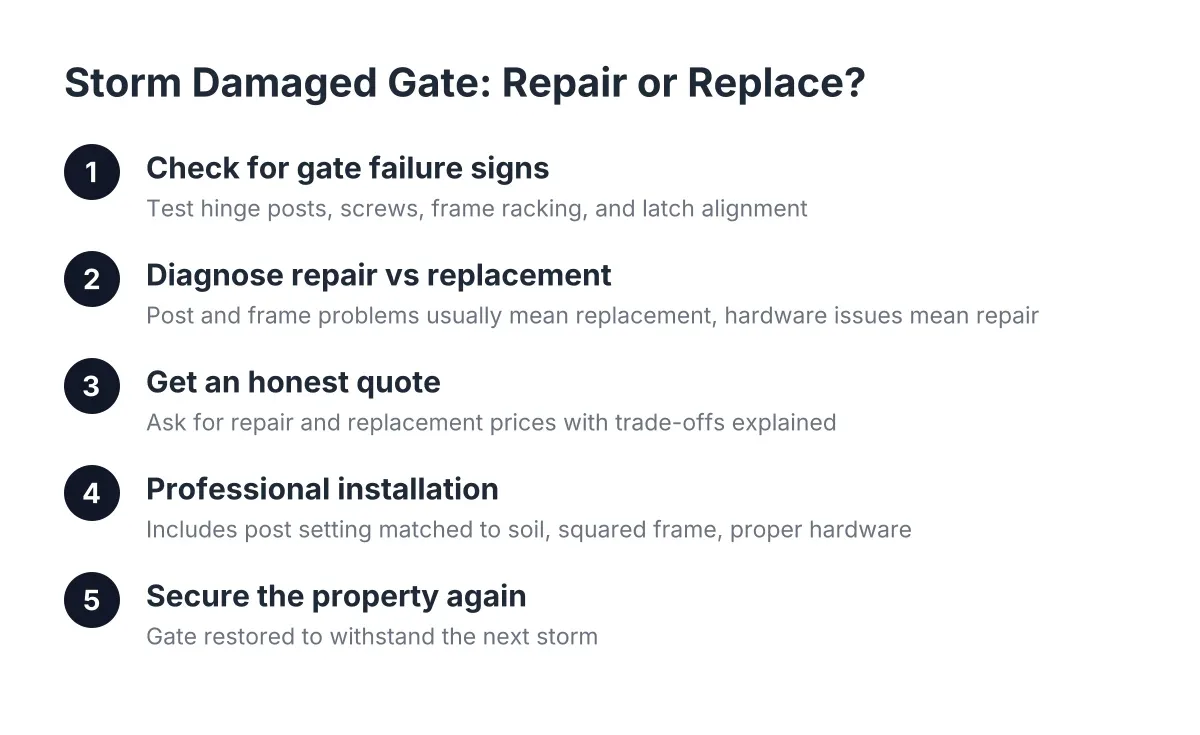
Here is what to check, in order:
- Grab the hinge post and push it. If it moves at the ground, the problem is below grade. A gate rehung on a loose post will sag again within months. Post problems usually mean resetting or replacing the post, not just the gate.
- Look at the hinge screws and brackets. Stripped screws, rusted-through hinges, or hardware torn out of the material can often be repaired if the post and gate frame are still sound.
- Check the gate frame for racking. Stand back and look at the gate as a rectangle. If it has twisted into a parallelogram, the frame joints have failed. Wood gates can sometimes be re-squared and braced. A racked vinyl gate with cracked uprights usually cannot.
- Inspect the latch side. If the latch no longer lines up, figure out whether the gate dropped or the ground shifted. In sandy soil, the ground moving is common, and it changes what the fix should be.
- Look down the whole fence line. A leaning gate attached to a leaning fence run is a bigger conversation. Patching one gate on a failing line wastes money.
As a general rule, hardware and latch problems lean toward repair. Post and frame problems lean toward replacement of that component, which sometimes means a new gate on a properly reset post rather than a whole new fence. Many storm calls land in the middle: the gate is salvageable, one post is not. When a storm damaged gate frame is beyond repair, the full replacement approach becomes necessary.
One honest caution. Hidden rot inside a wood post, or corrosion inside a chain link gate frame, is not visible from the outside. A repair that looks reasonable on inspection can turn into a replacement once the post comes out of the ground. A fair contractor tells you that possibility up front instead of discovering it on the invoice.
Is a Repair Quote Just an Upsell to Full Replacement?
Sometimes, but not when the reasoning is shown. A legitimate replacement recommendation points to specific failures: posts loose at grade, frame joints separated, rot or corrosion in structural members, or a fence line that has reached the end of its life. If a contractor cannot point to the specific failed component and explain why repairing it will not hold, ask more questions.
This fear is common after storms, and it is reasonable. Storm season brings out-of-town crews and companies that only sell new installs, so "you need a whole new fence" gets said a lot whether it is true or not.
Here is a useful test. Ask the estimator to walk the line with you and explain what fails next if you only do the repair. An honest answer sounds like "the gate and hardware are fine, but this post will not hold through another season, so reset the post and rehang the gate." A sales answer skips the specifics and jumps to the biggest number. You are allowed to ask for both a repair price and a replacement price, with the trade-offs of each explained plainly.
Insurance adds another wrinkle. Whether a policy covers storm damage to gates and fences depends on your coverage, so that question belongs with your agent, not your fence company. What a contractor can do is document the damage clearly in the estimate, which helps your claim either way.
What Professional Gate Installation Actually Includes
A proper gate installation covers more than hanging a gate on hinges. The scope should include post setting matched to the soil, a squared and braced gate frame, hardware rated for outdoor exposure, correct hinge and latch placement, and swing or slide clearance checked against the real ground, not the drawing. For automatic gate installation, add the operator, safety devices, power, and access controls.
Knowing the full scope protects you two ways. It tells you whether a quote is complete, and it tells you where corner-cutting hides.
Posts and Frame: The Foundation for Storm Damaged Gate Replacement
The post is the whole game in Bradenton. In sandy, sometimes saturated soil, gate posts need adequate depth and concrete sized for the load, and a heavy or automated gate often needs more than a standard fence post. In tight or awkward spots, such as butting against an existing structure, installers sometimes reinforce a post with a steel pipe core sleeved inside a vinyl post. That detail never shows in photos, but it decides whether the gate is still square in five years.
The frame comes next. A wood gate needs a brace against sag, and the direction of that brace matters; a rigid brace installed backward actually speeds up sagging rather than preventing it. Vinyl gates benefit from internal reinforcement inside the uprights so screws have something solid to bite into. Chain link gates rely on a welded or properly clamped frame with tension kept even.
Hardware and alignment finish the job. Good installers plan for ground movement rather than pretending it will not happen. For example, setting the latch striker with room to adjust means the gate still latches after the sandy soil settles over the next year. That one choice separates a gate that works in year three from one that needs a service call.
What is usually extra
Most quotes treat these as add-ons, so ask about them directly:
- Hauling away the old gate, posts, and concrete
- Automatic opener, safety sensors, and keypads on a motorized gate
- Electrical work to bring power to an electric gate operator
- Permit fees where your project requires one
- Regrading or drainage fixes where the gate swings
Cost Factors and Timelines for Gate Work
No honest contractor quotes a gate over the phone without seeing the site, and this article will not invent a price either. But the factors that move the number are predictable, and knowing them helps you read a quote.
For context on fencing overall, HomeAdvisor reports homeowners spend between $1,743 and $4,431 for a new fence installation, averaging $3,059 nationally, and chain link fences average $1,650 to $8,300 installed. According to Angi, the average homeowner spends $1,700 in labor for fence installation. Gate work scales differently because it concentrates labor and hardware in one opening, but those figures frame the broader project if your storm damage extends past the gate.
What drives gate cost up or down:
- Manual versus automatic. An opener, safety devices, and power supply make automatic gate installation a different budget category than a manual walk gate.
- Material. Wood, vinyl, and chain link each price differently, and marine-grade or powder-coated hardware costs more but earns it near the coast.
- Width and weight. A double driveway gate loads its posts far more than a garden gate, which changes post size, depth, and concrete.
- Site conditions. High water table, old concrete to remove, roots, or tight access all add labor.
- Repair versus replace. Resetting one post and rehanging an existing gate costs a fraction of a new gate and opener.
How long does it take to install a gate?
A standard manual gate on sound posts often takes a crew part of a day. If posts must be set in concrete, the concrete needs to cure before the gate hangs, which typically stretches the job across more than one visit. A motorized gate adds time for the operator, safety devices, and power, so plan in days rather than hours.
Timeline after a storm is its own subject. Demand spikes, materials run short, and every fence company in Manatee County has a full phone. Scheduling honesty matters more than speed promises; a contractor who commits to a date they can hit beats one who promises tomorrow and disappears.
Can I Fix a Storm-Damaged Gate Myself?
A homeowner can safely handle tightening hinge hardware, replacing a latch, and re-securing loose pickets or chain link fabric on an otherwise sound gate. Call a professional when a post moves at the ground, the frame has racked, the gate is wide or heavy, or an electric gate operator is involved. Those jobs fail, or injure, when done halfway.
The line is structural versus cosmetic. Swapping a rusted latch is a hardware-store trip. Resetting a post in saturated sandy soil to the right depth, with concrete sized for a driveway gate, is not a weekend guess. Get it wrong and the gate sags, drags, and stops latching, usually right before the next storm.
Automatic gates deserve a firmer line. A motorized gate is a moving machine with real force behind it, and the safety devices that stop it from closing on a person or a car have to be installed and tested correctly. Electrical work for an opener belongs with people licensed to do it. In addition, Florida and Manatee County have permitting rules that can apply to gates and fences depending on height, location, and whether the gate is automated, so check requirements with the county before any project in 2026 rather than assuming.
Warning signs that mean call now rather than wait:
- A gate or post leaning over a sidewalk, driveway, or neighbor's property
- A damaged gate that no longer secures a pool area
- An automatic gate that moves on its own, will not stop, or has exposed wiring
- A commercial lot gate that will not close and latch overnight
When the Gate Is Protecting a Business, Not a Backyard
Suppose a storm rolls through on a Thursday night and, come Friday morning, the sliding chain link gate on a small self-storage lot off 301 is jammed half open with a bent bottom rail. Nothing inside is damaged, but the lot cannot be secured, the insurance policy requires controlled access, and tenants are calling. In that scenario, the owner does not need a lecture on fence aesthetics. They need the opening closed today and a straight answer on whether the operator survived.
Commercial gate problems after storms follow that pattern. The priority order is secure the opening, assess the operator and track, then decide repair versus replacement. A temporary fix, such as chaining the opening or manually securing the gate, buys time to do the permanent work right instead of rushing a bad install. Commercial-grade chain link fence and gate hardware, heavier posts, and documentation for insurance or lease requirements all belong in that conversation.
Business owners should also ask about work scheduling. A gate that controls the only entrance to an auto lot or contractor yard cannot be torn out during business hours, so confirm whether the installer can stage work around your operation.
How to Choose a Gate Installation Company After a Storm
When half the companies you call do not call back and the other half only do new installs, picking the right one comes down to a few direct questions. Ask these before anyone measures anything:
- Do you repair, or only replace? A company that does both has no incentive to push you toward the bigger job when a repair will hold.
- How will you set the posts for this soil? Listen for specifics about depth, concrete, and sandy or wet ground. A generic answer here predicts a generic install.
- What failed on the old gate, and how does your plan prevent that failure? This is the question that separates estimators from installers.
A fair quote itemizes the work: posts, gate, hardware, opener if any, haul-away, and permits. It states what happens if hidden damage turns up once the old post comes out. It gives a realistic schedule window instead of a promise designed to win the job. Vague one-line quotes make disputes later; detailed ones prevent them.
Local knowledge is not a slogan in this trade. An installer serving Bradenton who has set posts in our sand, worked around flood-zone setbacks, and watched which gates survived the last few storm seasons makes different choices than one working from a national playbook. Those choices show up the next time the wind comes.
Getting Your Property Secure Again
If your gate is down or your fence took a hit, start with the ten-minute inspection above so you walk into estimates knowing what you are looking at. Then get the posts and the failure cause assessed by someone who will quote a repair when a repair is the right answer.
Manatee Fence Co installs and repairs wood fencing, vinyl fence, chain link fence, and automatic gate systems for homeowners and businesses in the Bradenton area. If you want a plain-language fence estimate, or a straight answer on whether your storm-damaged gate needs a repair or a replacement, reach out and we will walk the line with you and explain the options and cost factors before any work begins.
If you need automatic gate installation, Manatee Fence Co can help.
Prefer to talk it through? Call (941) 219-6611 — a quick call is usually the fastest way to get a straight answer for your situation.