LiftMaster vs. Mighty Mule: Choosing an Automatic Gate Opener in Bradenton
If you are comparing an automatic gate opener for a driveway or a commercial lot in Bradenton, two names come up again and again: LiftMaster and Mighty Mule. They sit at different ends of the market. Mighty Mule is the common DIY kit you see at big box stores. LiftMaster is the operator installers usually spec for daily-use driveways and commercial entrances. Both can be the right call. The wrong call is picking one without knowing how your gate, your usage, and Bradenton's heat, humidity, and storm season will treat it.
This guide breaks the comparison into seven practical points. Use it to evaluate the two brands the way a gate installer would: by duty cycle, gate weight, power, access control, and what happens after year two.
1. Know What Each Brand Is Built For
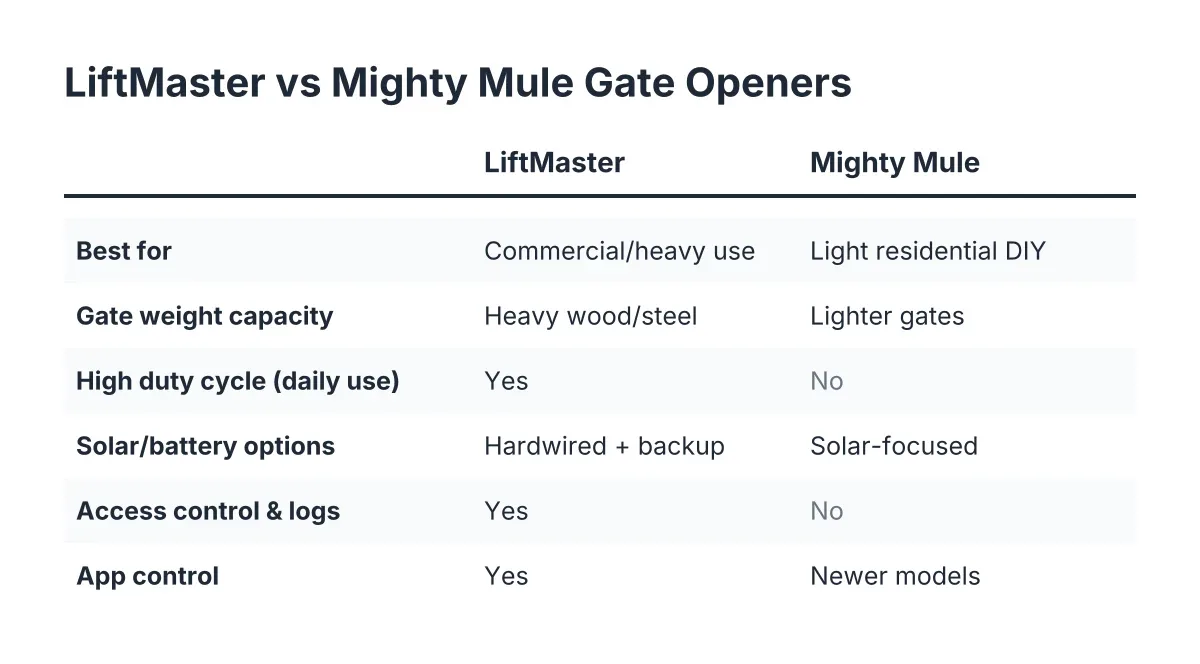
Mighty Mule builds consumer-grade gate opener kits aimed at light residential use. Think a single swing gate on a driveway that opens a handful of times a day. The kits are affordable and sold ready to install, which is why they dominate the DIY search results.
LiftMaster builds gate operators, which is the trade term for heavier-duty motorized gate systems. Their residential and commercial lines handle heavier gates, more daily cycles, and more add-ons like keypads, loop detectors, and access control. For a business securing a lot, or a home gate that runs twenty-plus times a day, that duty-cycle difference is the whole conversation.
2. Choosing the Right Automatic Gate Opener for Your Gate Weight and Length
Every opener is rated for a maximum gate weight and length, and exceeding either rating is the fastest way to burn out a motor. A light chain link gate panel and a solid wood privacy gate of the same width can differ in weight by a factor of several times. Wind load matters too; a solid gate in a Bradenton storm acts like a sail and strains the operator arm.
Mighty Mule kits generally cover lighter residential gates. LiftMaster's lineup extends into heavy wood, steel, and commercial chain link gates, including slide gate operators for lots where a swing gate would block parking or traffic. If your gate is heavy, long, or solid-faced, the comparison tilts toward the commercial-grade operator before you ever look at features.
3. Compare Duty Cycle, Not Just Price
Duty cycle means how many open-and-close cycles the opener can handle per hour or per day without overheating. This is where the two brands diverge most. A consumer kit on a commercial gate is the classic mismatch; it works fine for a month, then starts faulting during the busy part of the day.
For example, suppose a property manager in Bradenton runs a fenced equipment yard where trucks pass through forty times a day. In that scenario, a light-duty residential kit will likely fail early, while a continuous-duty LiftMaster operator is built for exactly that traffic. A homeowner whose pool-area driveway gate cycles six times a day has a different problem, and a Mighty Mule kit may serve them for years.
4. Weigh Power Options: Solar, Battery, and Hardwired
Power is often the deciding factor on Florida properties. Both brands offer solar-compatible systems, and a solar automatic gate opener makes sense in Bradenton where sun is plentiful and trenching power to a gate far from the building gets expensive. Mighty Mule leans heavily on solar and battery setups, which suits rural and long-driveway installs.
However, solar has limits. A high-cycle commercial gate can drain a solar battery faster than the panel recharges it, especially during a stretch of summer storms. Hardwired LiftMaster operators with battery backup keep the gate working through an outage, which matters for both security and for anyone relying on the gate as part of a pool or yard enclosure. Think through:
- How far the gate sits from the nearest power source, since trenching adds cost
- Daily cycle count, which determines whether solar can keep up
- Whether the gate must fail open or fail closed during a power outage
- Storm-season outages, and whether battery backup is a requirement for you
5. Look at Access Control and Smart Features
Remotes are table stakes; both brands include them. The differences show up in everything beyond the clicker. Mighty Mule offers keypads, app control on newer models, and basic vehicle sensors. That covers most single-family driveways.
LiftMaster goes further with its connected platform, letting a property manager grant and revoke codes, review open logs, and tie the gate into broader commercial gate access control. If multiple employees, tenants, or delivery drivers need in, that management layer saves real headaches. For a business owner who has dealt with trespassing or break-ins, an audit trail of who opened the gate and when is worth paying for.
6. Factor In Safety Devices, Especially Around Pools and Kids
An automatic gate is a moving machine, and modern automatic gate systems are expected to include entrapment protection like photo eyes or sensing edges that reverse the gate if something is in the path. Commercial-grade operators are designed around these devices. Budget kits support fewer of them, and DIY installs often skip them entirely, which is where injuries and liability start.
For homeowners installing or upgrading a gate as part of a pool enclosure, remember that the motorized driveway gate and the pool barrier serve different code purposes. Pedestrian gates in a pool barrier need self-closing, self-latching hardware, and placing the latch striker high on the gate helps it keep working as sandy Bradenton soil settles and the gate shifts over time. If an inspection deadline is driving your project, have a professional confirm the whole enclosure, not just the opener.
7. Think Past the Install: Heat, Humidity, and Repairs
Bradenton's climate is hard on gate hardware. Humidity and salt air corrode fasteners and control boards, intense sun degrades plastic housings, and sandy, low-lying lots shift posts so gates fall out of alignment. A misaligned gate forces the opener to drag the panel, and that extra load kills motors regardless of brand.
Therefore, judge each brand partly on serviceability. LiftMaster parts and commercial service support are widely available through professional installers, which keeps a failed board from becoming a full replacement. Mighty Mule parts are accessible too, but a worn-out consumer kit often costs nearly as much to rebuild as to replace. Cheap upfront can cost more over the life of the gate, the same way the cheapest fence bid often leads to an early rebuild.
Which Automatic Gate Opener Fits Your Property?
Choose a Mighty Mule opener when you have a light residential swing gate, modest daily use, solar-friendly siting, and comfort with DIY troubleshooting. Choose a LiftMaster operator when the gate is heavy or solid-faced, cycles frequently, protects a business lot, or needs keypads, backup power, and managed access codes. Usage, not brand loyalty, should decide it.
Here is the short version as a checklist:
- Light gate, few cycles per day, tight budget: Mighty Mule is a reasonable fit.
- Heavy wood or vinyl privacy gate exposed to wind: step up to a commercial-grade operator.
- Business lot with staff, deliveries, or tenants: LiftMaster with access control.
- Remote gate far from power: solar from either brand, sized honestly for your cycle count.
- Pool enclosure or inspection deadline: get professional eyes on the full barrier, not just the opener.
What Professional Automatic Gate Installation Includes
Professional gate installation covers more than mounting the operator. A full scope includes setting or reinforcing gate posts deep enough for sandy soil, hanging and squaring the gate, mounting and wiring the operator, installing safety photo eyes, programming remotes and keypads, and testing the obstruction reverse. Trenching for power, access control keypads, and vehicle exit sensors are often priced as add-ons, so ask what your quote includes.
Timelines vary with site conditions. A straightforward residential opener on an existing, well-hung gate often takes a day. A new commercial slide gate with trenched power and access control takes longer, especially if permitting is involved. In Bradenton, fence and gate projects can require permits, and flood-zone setbacks or wind exposure can shape the design, so confirm requirements before anyone digs.
DIY or Hire a Pro for Your Gate Opener?
A handy homeowner can install a light Mighty Mule kit on an existing, properly hung gate, and many do. The risks show up at the edges: undersized posts that lean in sandy soil, skipped safety sensors, electrical work, and gates that bind because they were never square to begin with. An opener cannot fix a bad gate; it just fails along with it.
Call a professional when the gate is heavy, the install involves trenching or hardwiring, the gate is part of a pool barrier under inspection, or the property is commercial and downtime matters. Searching for gate installation near me brings up plenty of options, so screen them with three questions: Have you installed this specific operator on gates like mine? How do you handle safety devices and obstruction testing? What does the quote include versus exclude? A fair fence estimate or gate quote spells out the operator model, posts, power plan, safety equipment, and who pulls any permit.
If you are weighing LiftMaster against Mighty Mule for a Bradenton driveway or a commercial lot, Manatee Fence Co can walk the site, look at your gate and power situation, and give you a straight recommendation with an itemized estimate for automatic gate installation. Reach out to schedule a visit, serving Bradenton homeowners and businesses with gates and fences built for this climate.
Prefer to talk it through? Call (941) 219-6611 — a quick call is usually the fastest way to get a straight answer for your situation.