Why Automatic Gates Fail in Florida: Humidity, Salt Air, and Sand
Here is something most gate brochures will not tell you: automatic gates fail in Florida faster than almost anywhere else in the country, and the reasons have little to do with the gate opener itself. The real culprits are humidity that never lets metal dry out, salt air drifting in from the Gulf, sandy soil that shifts under the posts, and summer lightning that cooks control boards. Understanding why automatic gates fail here—and what causes them to break down faster than in other regions—is essential before you invest in installation. If you own a home or a commercial lot in Bradenton and you are thinking about automatic gate installation, understanding these failure patterns before you buy will save you more money than any discount ever will.
This guide walks through why gates break down here, what a well-built installation looks like in our climate, what to expect on cost and timeline, and when a problem is a quick fix versus a call to a pro.
The Florida Problem: Why This Climate Eats Gates Alive
Automatic gates are electromechanical systems living outdoors, full time, with no shelter. In a dry climate, that is a manageable job. In coastal Florida, it is a constant fight on four fronts.
First, humidity. Bradenton air carries moisture most of the year, and that moisture works its way into every seam, hinge, bolt, and electrical enclosure on a gate system. Metal parts that would stay dry in Arizona sit damp here for days at a time. Corrosion starts at the fasteners and spreads inward.
Second, salt air. You do not need to be on the beach for salt to matter. Gulf air carries salt miles inland, and salt accelerates corrosion on steel hardware, chain, hinges, and the small internal parts of a gate operator. A metal fence gate that would last decades in the Midwest can show rust streaks within a few years here if the coating and hardware were chosen carelessly.
Third, sandy and low-lying soil. Much of Manatee County sits on sand with a high water table. Posts set in sand move. When a post moves even a small amount, an automatic gate stops closing cleanly, the latch misses, the operator strains, and the motor wears out early.
Fourth, storms. Summer lightning is a leading killer of gate control boards, and hurricane-season wind loads test every weld and hinge on the gate panel itself.
None of this means automatic gates are a bad idea in Bradenton. It means the installation has to be designed for this place, not copied from a national spec sheet.
How Automatic Gates Fail in Florida, Part by Part
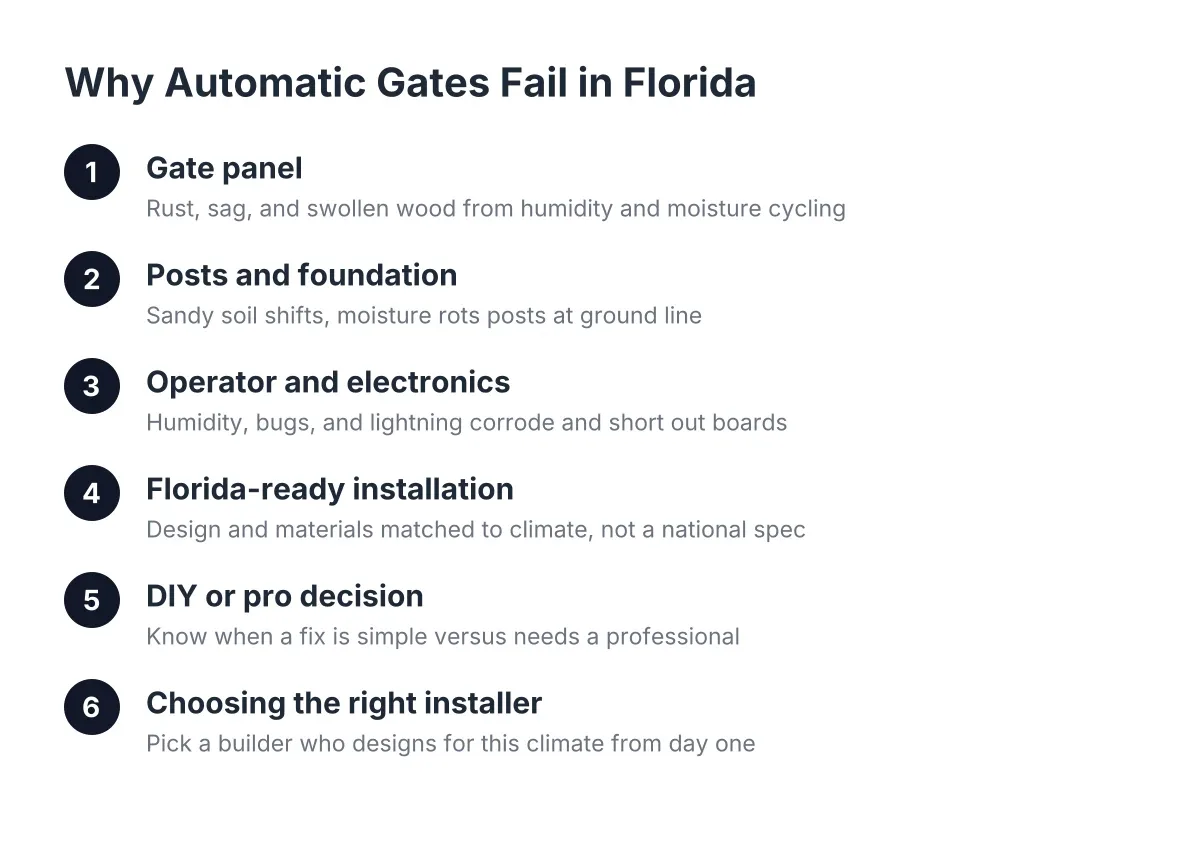
It helps to think of a gate system as four subsystems: the gate panel, the posts and foundation, the operator, and the electronics. Florida attacks each one differently.
The gate panel: rust, sag, and swollen wood
Steel and iron gates corrode from the fasteners outward. Welds, bolt holes, and anywhere the powder coating gets chipped become entry points for salt and moisture. Aluminum resists rust and is a common choice near the coast for that reason, though it needs proper bracing because it is lighter.
Wood gates have a different enemy: moisture cycling. Wood swells in the wet season and shrinks in the dry season. A 6 ft wood fence gate that fit its opening in April can bind against the latch post by August. Wood gates also sag, and a sagging gate forces the operator to drag dead weight every cycle.
Vinyl gates avoid rust and rot, but the frame matters. Screws driven into hollow vinyl uprights work loose over time. Well-built vinyl gates use internal reinforcement inside the uprights so the hinge screws bite into something solid. The hinge side carries the load and needs that reinforcement; the latch side rarely rips out and usually does not.
One detail that separates careful installers from careless ones: anti-sag bracing. A flexible cable brace and a rigid bar brace install in opposite orientations. A rigid brace installed the way a cable brace would go actually speeds up sagging instead of preventing it. It is a small mistake with a slow, expensive result.
Posts and foundations: where sandy soil wins
The most common foundation failure we see described across the trade is not the concrete itself. It is the top of the hole. When an installer pours concrete to a couple of inches below grade and backfills the rest with dirt or sod, moisture concentrates right at the ground line where the post exits the soil. That contact point becomes the first place a wood post rots or a steel post corrodes, which shortens the post's working life considerably.
Ground movement adds to this. Sandy soil settles, and a gate that was aligned perfectly on day one can drift out of alignment over the first year. Experienced installers plan for this. One practical example: setting the latch striker near the top of the latch's adjustment range so the gate still catches as the ground settles. For tight spots, such as a gate butting against an existing fence line, a vinyl post can be sleeved over a metal pipe for extra rigidity.
The operator and electronics: humidity, bugs, and lightning
Gate operators are motors and gears in a box. In Florida, that box fills with humid air every day. Condensation corrodes circuit boards, limit switches, and connectors. Ants and other insects nest inside operator housings and short out boards more often than most owners would guess.
Then there is lightning. The Tampa Bay region sees some of the most intense lightning activity in the country, and a gate operator sits at the end of a long run of wire, which acts like an antenna for surges. Without surge protection, one close strike can destroy a control board. Photo-eye sensors and safety loops also drift out of alignment as posts shift, which causes the classic Florida complaint: the gate opens but refuses to close.
What a Florida-Ready Gate Installation Includes
When you ask for a quote on automatic gate installation, the scope of work should be spelled out, not implied. A complete job for Bradenton conditions generally covers:
- Site assessment, including soil, drainage, slope, and distance to power
- Gate panel fabrication or supply in a material matched to your exposure
- Posts set in full-depth concrete footings, poured to grade, not backfilled with sod
- The gate operator, sized to the gate's weight and daily cycle count
- Safety devices, including photo eyes and reversing sensors, which modern operators require
- Access control, such as keypads, remotes, or phone-based entry
- Electrical connection, surge protection, and weather-sealed enclosures
- Permits where the work requires them, which varies by county and scope
Items that are often extra include trenching long electrical runs, solar power packages for lots without nearby power, vehicle detection loops cut into pavement, and intercom or camera systems. Ask which of these your quote includes before you compare numbers. Two quotes that look far apart often describe two different jobs.
For a commercial lot, the gate rarely stands alone. Suppose you run a contractor yard off SR 64 and insurance now requires controlled vehicle access. In that scenario, the project usually pairs a chain link fence perimeter with a slide gate and operator, and the gate is the single most expensive line item on the job. Getting the gate right matters more than shaving cost on fabric and posts.
What Do Automatic Gates Cost and How Long Does Installation Take?
Automatic gate installation costs vary widely because the gate panel, the operator, the power run, and the site conditions all move the number independently. Instead of quoting a figure, it is more honest to explain the factors. A short aluminum swing gate on a lot with power nearby sits at the low end. A long commercial slide gate with a trenched electrical run, vehicle loops, and keypad entry sits several multiples higher.
For context on the fencing side of a combined project, fence installation costs average $3,277 nationally according to Angi, and chain link fences run an average of $1,650 to $8,300 installed according to HomeAdvisor. A motorized gate adds its own equipment and electrical costs on top of whatever a wood fence cost calculator or chain link estimate suggests for the fence itself. Treat online calculators as rough starting points; they do not know about your soil, your power location, or your HOA.
On timeline, most residential gate projects run from a few days to a couple of weeks once work starts, because concrete footings need cure time before a heavy gate hangs on them. Permitting, HOA approval, and custom fabrication add lead time before the crew ever arrives. As of 2026, permit requirements in the Bradenton area depend on the scope and location of the work, so confirm what applies to your parcel before anyone digs.
The main cost drivers, in plain terms
- Gate size, weight, and material, since heavier gates need stronger operators
- Swing versus slide design, which changes hardware and site prep
- Distance from the gate to the nearest power source
- Access control features, from a basic remote to keypads and phone entry
- Soil and drainage conditions that affect footing depth and design
- Safety and code requirements, especially on commercial properties
Why Automatic Gates Fail Faster When Installed Wrong
An automatic gate that fails in Florida within a few years usually fails because of decisions made on installation day, not because of the climate alone. The climate just exposes shortcuts faster than a gentler one would.
Here is a hypothetical that plays out often enough to be familiar. Say a new-build homeowner in Bradenton gets three quotes for a driveway gate, takes the cheapest, and the crew sets the posts in shallow concrete topped with sod. The first summer, the posts shift in the wet sand. By fall, the gate drags, the photo eyes misalign, and the operator faults out every few cycles. The repair bill to reset posts and realign everything erases the savings, and the homeowner now distrusts the whole category.
Compare that with a job planned for the site: footings poured to grade, hardware rated for salt exposure, the striker set with room to adjust as the ground settles, and a surge protector on the operator. Same climate, different outcome. The installation quality is the variable, not Florida.
This is also why the fence and the gate should be planned together. The gate hangs on posts that are part of the fence line, and a privacy fence or vinyl fence run that ignores the gate loads will give you a weak hinge post. Good gate installation starts with the fence plan, not after it.
DIY or Pro: Where to Draw the Line
Homeowners can safely handle the maintenance side. Reasonable DIY tasks include:
- Rinsing salt film off metal gates and hardware a few times a year
- Wiping photo-eye lenses and clearing vegetation from sensor paths
- Lubricating hinges and rollers with a product rated for outdoor metal
- Replacing remote batteries and testing the manual release
- Checking that the gate swings or slides freely with the operator disengaged
The installation itself is a different matter. An automatic gate is a heavy moving machine with electrical work, safety sensor requirements, and in many cases permit obligations. A gate installed without proper reversing sensors is a genuine hazard, especially where children or customers pass through. Electrical connections, footing design, and operator programming belong with a professional, and some repairs involve stored spring tension or live power that an owner should not open up.
Call a pro now, not later, if you notice any of these warning signs: the gate reverses or stalls mid-cycle, it closes on obstructions without reversing, the operator hums without moving, posts visibly lean, or the gate drags the ground at any point in its travel. Each of those gets more expensive the longer it runs.
Choosing an Installer Who Builds for This Climate
You do not need to become a gate expert to hire well. Three questions will tell you most of what you need to know.
First, ask how they set posts in sandy, high-water-table soil, and how far up the hole the concrete goes. A good answer describes full-depth footings poured to grade and explains why. A vague answer about "standard depth" is a yellow flag in Manatee County.
Second, ask what corrosion protection the hardware and operator enclosure carry, and whether surge protection is included. In this climate those are not upgrades; they are the difference between a ten-year gate and a three-year gate.
Third, ask what the quote includes and excludes, line by line: permits, electrical runs, safety sensors, access control, and haul-away. A fair fence estimate or gate quote explains the factors driving the price rather than handing you one bare number. If an installer cannot explain why their price is what it is, they are guessing, and you will pay for the guess later.
One honest trade-off to weigh: building for Florida conditions costs more up front. Marine-grade hardware, deeper footings, aluminum or reinforced vinyl panels, and surge protection all add to the initial bid. The payback comes in fewer service calls and a longer working life, but if the budget is tight, it is better to build a smaller gate correctly than a bigger one cheaply.
Getting It Right the First Time in Bradenton
Automatic gates fail in Florida for predictable reasons: humidity and salt corroding metal, sandy soil shifting posts, lightning hitting electronics, and installation shortcuts that the climate exposes within a season or two. Every one of those failure modes has a known countermeasure, and all of them cost less to build in than to fix after the fact.
If you are planning a new fence and gate for a bare lot, or securing a commercial yard with an electric gate and chain link perimeter, start with a conversation about your site, not a catalog. Manatee Fence Co handles automatic gate installation along with wood fencing, vinyl, and chain link fence work, serving Bradenton and the surrounding area. Reach out for an estimate, and expect plain answers about materials, cost factors, and what your specific soil and exposure call for. That conversation is free, and it is the single best protection against joining the list of gates this climate has already beaten.
If you need automatic gate installation, Manatee Fence Co can help.
Prefer to talk it through? Call (941) 219-6611 — a quick call is usually the fastest way to get a straight answer for your situation.