Vinyl Fence Installation Timeline: How Long From Contract to Completion
If you just closed on a new home in Bradenton with a bare lot, the first question after "how much" is usually "how long." The vinyl fence installation timeline runs from the day you sign a contract to the day the last post cap goes on, and most of that time is not spent digging holes. Permits, HOA paperwork, utility locates, and material lead times usually take longer than the install itself. This guide walks through each stage in order so you can plan around pets, kids, move-in dates, or, if you manage a commercial lot, around business hours and deliveries.
Here is the short version. For a typical residential perimeter in 2026, expect one to four weeks from signed contract to a crew on site, then one to three days of actual installation. Commercial jobs with gate access systems or long runs take longer. The steps below explain where that time goes and where you can shave days off.
Step 1: Get Your Estimate and Sign the Contract
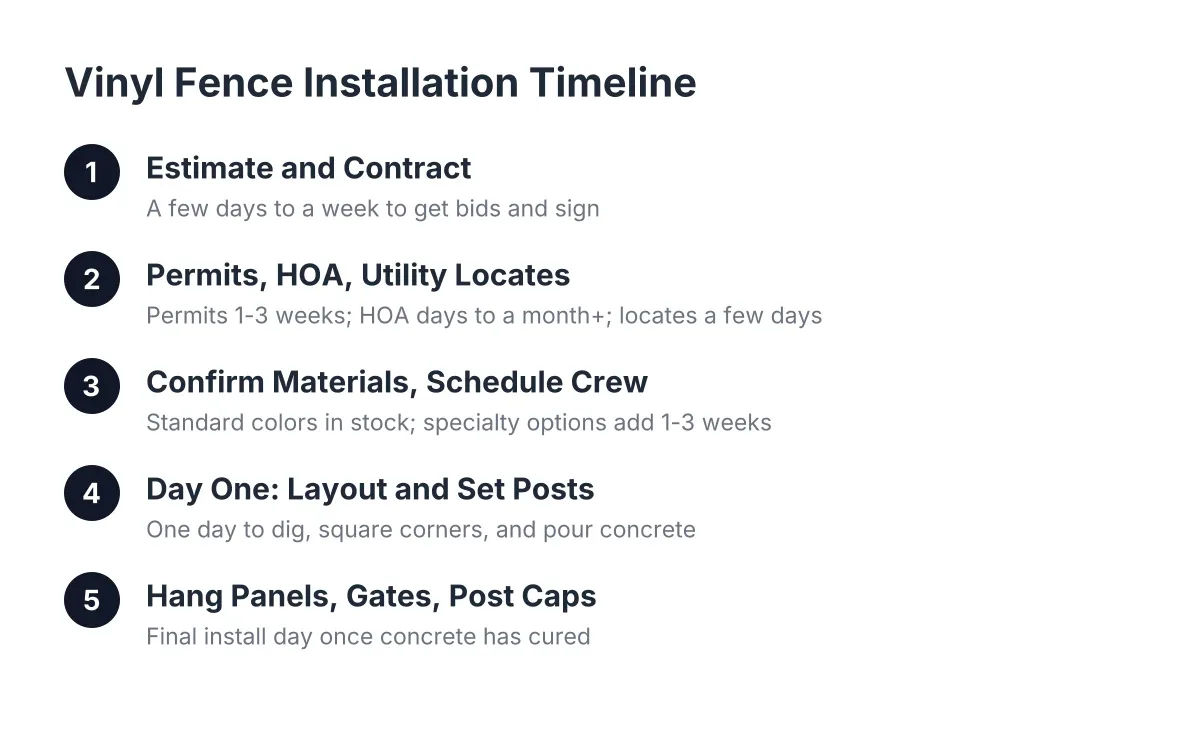
Start by getting a written fence estimate that spells out footage, fence height, style, gate locations, and who pulls the permit. This stage usually takes a few days to a week, depending on how fast you can meet for a site visit and how many quotes you are comparing.
Most new homeowners compare two or three bids. That is smart, but compare the scope, not just the bottom line. A cheap bid that skips permit handling or uses thin-wall posts costs more later. A fence that has to be rebuilt early costs more over time than paying for solid work upfront.
For context on budget, Angi reports that vinyl (PVC) fencing costs between $15 and $40 per linear foot on average, and that fence installation averages $3,277 nationally. Your number depends on footage, gate count, and site conditions, so treat those figures as a starting point, not a quote.
Timeline tip: have your property survey ready at the first meeting. On a new build you usually received one at closing. A survey settles property lines immediately and keeps the project from stalling later over a disputed boundary.
Step 2: Permits, HOA Approval, and Utility Locates in Your Vinyl Fence Installation Timeline
Next comes the paperwork stage, and it is the longest part of most vinyl fence installation timelines. In the Bradenton area, fence permits typically take one to three weeks depending on the jurisdiction and workload. Low-lying lots and flood-zone setbacks can add review time, so a lot near a drainage easement may need extra documentation.
If you have an HOA, submit your application the same week you sign the contract. HOA design review can take anywhere from a few days to a month or more. This is the single most common cause of a stalled fence project, and it is entirely out of the installer's hands.
Before any digging, underground utilities must be located and marked. That locate request usually takes a few business days. Skipping it is not an option; a cut cable or gas line turns a two-day job into a two-week problem.
During this stage, expect:
- Permit application and approval: one to three weeks, varies by jurisdiction
- HOA design review, if applicable: days to a month or more
- Utility locate marking: a few business days
- Material ordering: standard white vinyl is often in stock; custom colors or heights can add one to three weeks
Therefore, the waiting stage runs in parallel. A good installer orders materials while the permit is in review so both finish around the same time.
Step 3: Confirm Materials and Schedule the Crew
Once the permit clears, confirm your material order and lock in an install date. Standard white or tan PVC fence panels in common heights are usually available quickly. However, specialty colors, wood-grain textures, or taller privacy panels for a commercial lot may be special-order items with their own lead time.
Scheduling also depends on season. In Florida, demand spikes before hurricane season and after storms, when fence repair and fence replacement calls stack up. If you are searching for vinyl fencing installers near me in late summer, expect a longer queue than in winter.
For a commercial property, this is the stage to coordinate downtime. Suppose you manage a contractor's yard off a busy Bradenton corridor and need the lot secured without blocking morning deliveries. In that scenario, the installer can set posts along the back line one day, then close the front and hang the gate on a slower day. Raise that early so the schedule is built around your operation, not the other way around.
Step 4: Day One on Site, Layout and Setting Posts
Installation day one is layout and posts. The crew marks the fence line from your survey, squares the corners, and digs post holes. Posts are the foundation of a vinyl fence; they carry the structural load that keeps panels straight for years, so this day matters more than any other.
In Bradenton's sandy, often wet soil, post depth and concrete work carry extra weight. Sandy ground does not grip a post the way clay does, and a high water table can mean wet holes. Crews account for that with hole depth and concrete volume. Each post's rail openings must line up exactly along the fence line before concrete is poured; a post set a few degrees off makes the panel either bind or sag.
Difficult spots get special treatment. For example, a post butting against a neighbor's existing fence or squeezed beside a tree may get a steel pipe core with the vinyl post sleeved over it for strength. Gate posts for a motorized gate or electric gate on a commercial drive often get reinforcement too, since the gate hardware loads the post every time it swings or slides.
For most residential perimeters, post setting takes one day. The concrete then needs time to cure before panels go on, usually overnight to a full day depending on conditions.
Step 5: Hang Panels, Set Gates, and Cap the Posts
With the concrete cured, panel day moves fast. Rails are cut to fit snugly between posts and secured, pickets drop into the rails, and side strips hold grooved pickets in place along each post. On sloped sections, crews can reverse their building direction so pickets do not slide downhill as they go in. Gates get hung, latched, and adjusted.
The finishing touch is the post caps. Caps are glued on with PVC cement so they seal permanently and do not blow off in a summer storm. Once the caps are set, the crew cleans up concrete spoils and packaging, and the fence is done.
A typical residential vinyl fence installation wraps up in one to three days on site:
- Day one: layout, dig, set posts in concrete
- Overnight or day two: concrete cures
- Day two or three: rails, pickets, gates, caps, cleanup
Commercial jobs run longer. A long perimeter with an automatic gate installation can add several days for gate operator wiring, access controls, and testing.
What Stretches the Vinyl Fence Installation Timeline
The most common delays in a vinyl fence installation timeline are permits, HOA review, weather, and special-order materials. Site surprises matter too: buried construction debris on a new-build lot, roots, irrigation lines the builder never mapped, or standing water after heavy rain can each add a day or more.
Florida weather is the wild card. Summer afternoon storms can pause concrete work, and a named storm can push the whole schedule. Vinyl itself handles the climate well; it resists rot and fading far better than wood fencing in our sun and humidity, which is part of why it is a popular pick for vinyl fence installation in Florida.
One honest trade-off: vinyl costs more upfront than chain link fence and most wood options, and repairs mean replacing panels rather than patching boards. If your lot has steep grade changes, major drainage issues, or a flood-zone setback question, have a professional walk it before you commit to a layout. That hour can save a week of rework.
A Realistic Start-to-Finish Example
Say a couple closes on a new-construction home in Bradenton in early March with a bare quarter-acre lot and a dog that needs containment. Here is an illustrative schedule for that scenario.
- Week 1: site visit, written estimate, contract signed, survey handed over
- Weeks 2 to 3: permit in review, HOA application submitted, materials ordered, utilities located
- Week 4: permit approved, install scheduled
- Week 5, day one: posts set in concrete
- Week 5, day two: panels, gates, and caps installed; dog fenced by dinner
That is about five weeks contract to completion, and most of it was waiting on paperwork, not labor. A commercial lot adding a motorized gate might run seven to nine weeks on the same logic, with gate operator lead time as the long pole.
Plan backward from the date you need the fence, add a buffer for permits and weather, and get the paperwork moving the same week you sign. The crew's part is fast. The calendar's part is what you control by starting early.
If you need vinyl fence installation, Manatee Fence Co can help.
Prefer to talk it through? Call (941) 219-6611 — a quick call is usually the fastest way to get a straight answer for your situation.