Rolling Gate vs. Swing Gate: Which Suits Your Bradenton Property?
Choosing between a rolling vs swing gate comes down to your driveway, your lot, and how the gate will be used day to day. In Bradenton, sandy soil, tight commercial lots, and storm-season wind all push that rolling vs swing gate decision one way or the other. This guide walks through seven practical factors so you can weigh both options before you ask anyone for a fence estimate.
A quick definition before the list. A swing gate pivots on hinges, like a door, either as a single panel or a double. Additionally, a rolling gate (often called a sliding gate) moves sideways along the fence line, either on a ground track or on a cantilever system that floats above the driveway. Both can be manual or motorized, and both work with chain link, metal, wood, and vinyl fence construction.
1. Measure Your Clearance First: The Core Rolling Gate vs. Swing Gate Question
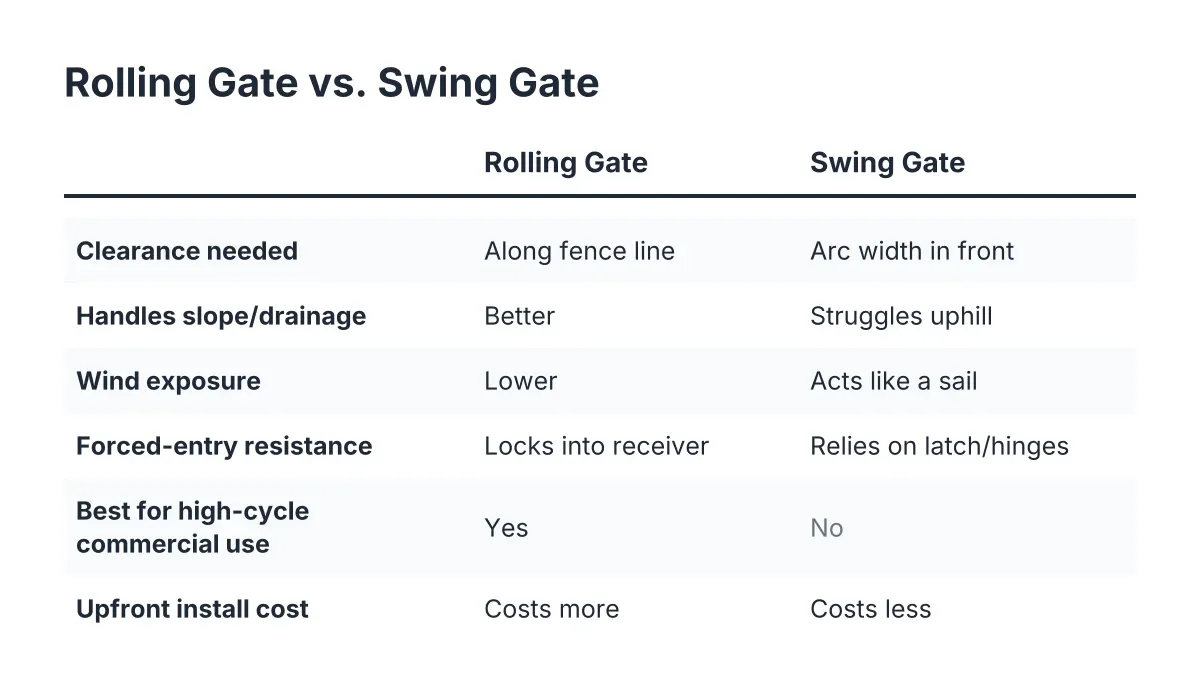
What is the difference between sliding gates and swing gates in practice? A swing gate needs open space in front of or behind the opening equal to the gate's width, so the panel has room to pivot. A rolling gate needs clear space along the fence line beside the opening, roughly the gate width plus extra for the counterbalance on cantilever systems.
This one factor settles most decisions. Suppose you manage a commercial lot off Cortez Road with equipment parked close to the entrance. A swing gate would need that parking area kept clear every time the gate cycles. A rolling gate slides along the inside of the fence instead, so trucks can stage right up to the opening.
For a rental property with a standard residential driveway and a yard behind the gate, the swing style usually wins. There is room for the arc, and the hardware costs less. The rule of thumb: short on depth, go rolling; short on width along the fence line, go swing.
2. Factor In Bradenton's Slope and Drainage
Swing gates struggle on driveways that slope up toward the property. The bottom edge of the panel drags as it opens uphill, which forces you to either raise the gate and leave a gap underneath or limit how far it opens. On low-lying Bradenton lots where driveways are crowned for drainage, that gap can get large enough to defeat the purpose of a security fence.
Rolling gates handle slope better because the panel moves sideways instead of sweeping across the grade. A cantilever rolling gate is the strongest choice here, since it has no ground track to collect sand, shell, or standing water after a summer storm. Ground-track systems work, but around here the track needs regular clearing or the rollers bind.
If your lot floods during heavy rain, mention it when you get quotes. Post depth, concrete footings, and track type all change based on the water table, and a gate set wrong in wet sandy soil will shift out of alignment within a season or two.
3. Think About Wind Load Before You Pick a Panel Style
Storm-season wind is a real design input in Manatee County, not an afterthought. A solid swing gate panel acts like a sail; a strong gust can slam it, strain the hinges, or bend the operator arm on an electric gate. Rolling gates ride on rollers and a track or carriage, so wind pushes against the whole fence line rather than levering one hinged panel.
That does not mean swing gates fail in wind. It means the design has to account for it:
- Chain link or open-picket metal gate panels let wind pass through and cut wind load sharply.
- Solid privacy fence style gates, in wood or vinyl, catch the most wind and need heavier posts and hinges.
- Automatic swing gate operators should include slowdown and stop settings so gusts do not fight the motor.
- Any gate, rolling or swing, should be securable in the closed position before a storm.
For a commercial lot storing inventory outside, an open chain link rolling gate is a common pick: it sheds wind, slides clear of the drive, and pairs well with commercial gate access control.
4. Compare Security and Access Control Needs
If the trigger for this project was a break-in or people cutting through your lot, gate choice affects how hard the entrance is to defeat. Rolling gates lock into a receiver post and cannot be forced open by pushing, since the panel moves sideways against its own track. Swing gates rely on the latch and hinges, which are the usual failure points when someone forces entry.
Hinge-side hardware deserves attention on any swing gate. On vinyl gates especially, the hinge side takes the stress, and reinforcing that post with an internal insert keeps screws from pulling out over time. The latch side rarely fails the same way, but on sandy Bradenton lots the ground settles, so a latch striker set with room to adjust keeps the gate catching cleanly as posts shift.
For access control, both styles accept a driveway gate opener, keypad, card reader, or phone-based entry. Rolling gate operators tend to suit high-cycle commercial use, where the gate opens dozens of times a day. Swing operators are the standard for residential and light rental-property use.
5. Weigh the Cost Difference Between Rolling and Swing Gates
Sliding gate vs swing gate cost comparisons usually come out the same way: swing gates cost less to install for a standard driveway, and rolling gates cost more because of the track or cantilever hardware, the longer panel, and the heavier operator. The gap widens when you add automation, since rolling gate motors and their carriage systems run above comparable swing operators.
However, the cheaper option up front is not always cheaper over the life of the gate. A swing gate forced onto a sloped or cramped site needs more adjustment calls. A ground-track rolling gate on a sandy lot needs the track cleared or it eats rollers. Matching the gate type to the site is what keeps repair visits off your calendar.
For context on the fencing side of a project, fence installation costs average $3,277 nationally according to Angi, and chain link fences run an average of $1,650 to $8,300 installed according to HomeAdvisor. Gate hardware, automation, and site conditions sit on top of the fence itself, so treat those as separate line items when you compare quotes.
6. Match the Gate to the Property Type You Own or Manage
A small landlord with a handful of rentals in Bradenton has different needs than a business owner securing a commercial yard, and the rolling vs swing gate choice usually splits along those lines.
For rental houses, a manual swing gate in chain link or wood fencing is the workhorse. It is simple for tenants to use, cheap to repair between leases, and easy to replace a panel on after storm damage. If a lease requires a fenced yard, a basic swing gate on a privacy fence satisfies it without adding a motor a tenant can break.
For commercial lots, a rolling gate earns its cost when any of these apply: the drive slopes, vehicles stage near the entrance, the opening is wide, or the gate cycles many times a day. Say you run a contractor's yard near SR 70 with box trucks coming and going all day. In that scenario, a motorized chain link rolling gate with keypad access keeps the lot secure without a driver ever leaving the cab, and installation can usually be staged so the entrance stays usable during business hours.
7. Plan for Installation Time, Permits, and Professional Setup
How long does it take to install a gate in Bradenton? A manual swing gate on existing posts often takes a day or less. A new automatic gate installation, rolling or swing, typically runs longer: setting posts in concrete, letting footings cure in sandy soil, mounting the operator, running power, and programming safety sensors. Rolling gates add track or cantilever work, so plan on the longer end.
Permits matter here too. Manatee County and the City of Bradenton have rules on gate setbacks, swing direction toward the street, and automated gate safety devices, and flood-zone lots can carry extra requirements. Check requirements before work starts; a gate that swings into the right of way or lacks required safety reversing sensors can fail inspection in 2026 just as it would have last year.
This is also where professional gate installation pays for itself. A gate hung out of square sags within months, drags on the drive, and burns out an electric gate operator that has to fight the misalignment. Proper installs square and brace the panel before hanging, set anti-sag hardware oriented the right direction, and position latch hardware to tolerate ground movement. If your project involves a motorized gate, a wide commercial opening, or a flood-zone lot, have a professional handle the layout and electrical work rather than treating it as a weekend job. Searching for fence installation near me will turn up plenty of options; ask each one how they handle sandy soil, wind load, and gate operator sizing before you sign.
The Short Version: How to Decide
Here is the decision path most Bradenton property owners can follow:
- Check clearance. No room for a panel to swing? Rolling gate.
- Check slope. Driveway rises toward the gate? Rolling gate, cantilever style.
- Check usage. Dozens of cycles a day on a commercial lot? Rolling gate with a commercial operator.
- Standard flat residential driveway with yard space? Swing gate, manual or with a driveway gate opener.
- Rental property on a budget with tenant turnover? Manual swing gate in chain link or wood.
- Storm exposure on an open lot? Favor open-picket or chain link panels either way.
Neither style is better across the board; each wins on specific sites. The trade-off is consistent: swing gates cost less and suit simple flat sites, while rolling gates cost more but solve slope, space, and heavy-use problems that swing gates cannot. Walk your lot with those six checks in mind, and the right answer for your property usually makes itself obvious before the first quote arrives.
If you need automatic gate installation, Manatee Fence Co can help.
Prefer to talk it through? Call (941) 219-6611 — a quick call is usually the fastest way to get a straight answer for your situation.