Gate Installation Permits and Regulations in Florida: What to Know First
Most people who call about a new driveway gate ask about price first and permits second, if they ask at all. That order is backwards. In Florida, gate installation permits and regulations shape what you can build, where you can build it, and how the project gets inspected before you ever pick a material or a motor. Skip that step and you can end up with a gate the county makes you move, modify, or tear out. Understanding how gate permits work in Florida is essential before you begin any installation.
This guide walks through how permitting works for gates in Florida, with a focus on the Bradenton and Manatee County area. It covers when you need a permit, what the rules actually regulate, what changes when the gate is motorized, and how commercial properties face a different set of requirements than a homeowner fencing a new lot. None of this is legal advice, and rules change. But by the end you should know what questions to ask your local building department and your installer before any post goes in the ground.
Why Permits Exist for Something as Simple as a Gate
A gate looks like a small project. It is a frame, some hinges, and a latch. So why does a building department care?
The short answer is that gates sit at the intersection of several things local governments regulate: property lines, sight lines for drivers, drainage, wind load, and, when the gate is motorized, electrical work and mechanical safety. A fence panel that fails in a storm falls over. A heavy steel gate that fails can fall on a person or a car. Additionally, a motorized gate that closes on someone without working safety sensors is a serious hazard, which is why automated gates have their own safety standards separate from fence rules.
In coastal Florida, wind is the other big driver. Gates and fences here have to be built with storm-season wind exposure in mind. Permitting is how counties check that posts are set deep enough, that materials are rated for the exposure, and that the structure will not become debris in a hurricane. On Bradenton's sandy, low-lying lots, post depth and footing design matter even more, because loose soil and a high water table give posts less to hold onto.
So the permit is not paperwork for its own sake. It is the county's way of checking the things that fail when a gate is installed wrong.
Do You Need a Permit to Install a Gate in Florida?
In most Florida jurisdictions, a gate that is part of a fence falls under fence permitting rules, and many counties and cities require a permit for new fence and gate installation. Motorized or electric gates almost always require a permit because they involve electrical work and safety equipment. The honest answer is that it depends on your county, your city, and sometimes your specific lot.
Here is the frustrating part for property owners: Florida does not have one statewide rule that says "fences and gates need a permit" or "they don't." Permitting is handled at the county and municipal level. Manatee County has its own process. The City of Bradenton has its own. A property in Palmetto or an unincorporated pocket of the county may answer to different offices with different forms.
That said, a few patterns hold across most of Florida:
- New fence and gate installation usually requires a permit or at least a zoning review. Even where the fence itself is exempt, the location, height, and setbacks still have to comply with zoning.
- Motorized and automatic gates almost always require a permit. The gate operator involves electrical wiring, and powered gates must meet national safety standards for entrapment protection.
- Repairs are treated differently than new installs. Replacing a sagging gate leaf in the same spot is often simpler, permit-wise, than adding a new gated opening.
- Flood zones and easements add review steps. Much of the Bradenton area sits in or near flood zones, and drainage easements can restrict where posts and gates may go.
- Corner lots get extra scrutiny. Sight-triangle rules limit fence and gate height near intersections and driveways so drivers can see oncoming traffic.
If you take one thing from this section, take this: call your local building department or check their website before you commit to a design. A ten-minute conversation now beats a stop-work order later.
What Gate Installation Permits and Regulations Actually Cover
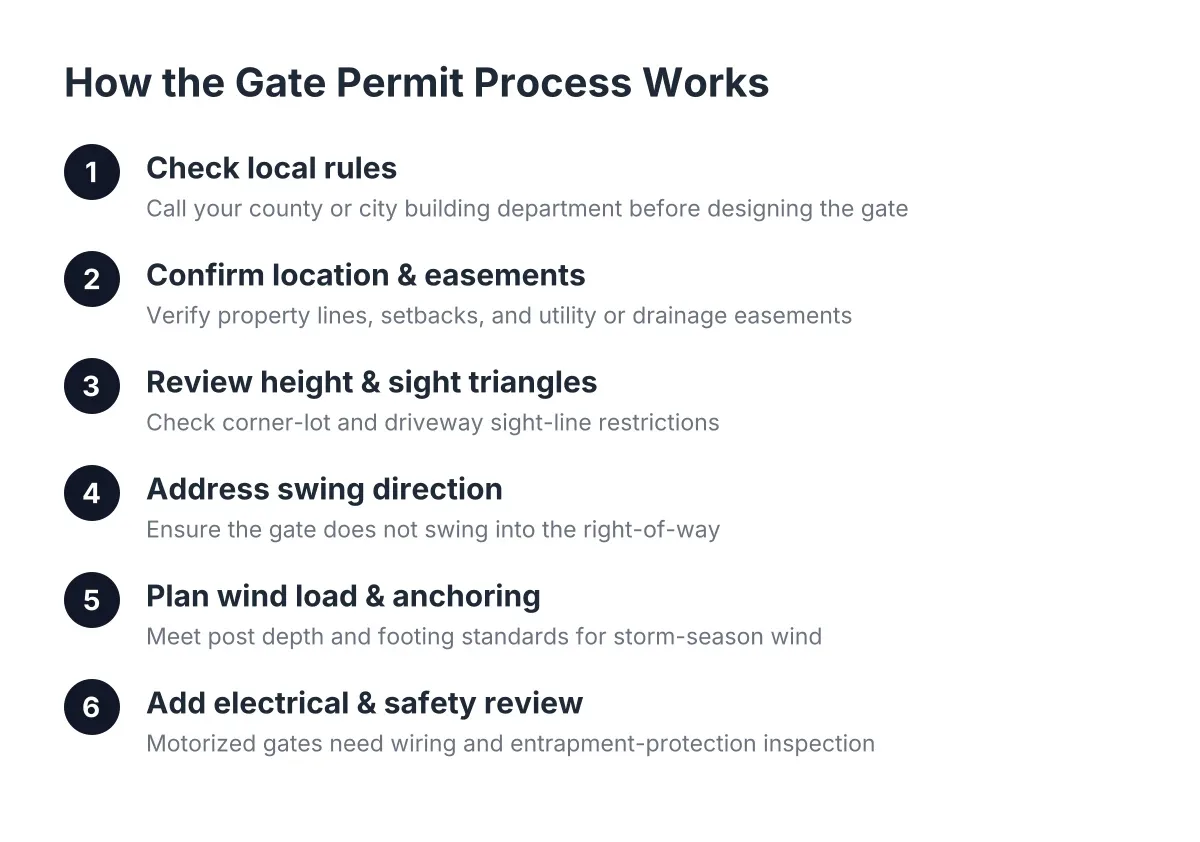
Gate installation permits and regulations in Florida generally cover five things: where the gate sits relative to property lines and easements, how tall it can be, how it swings or slides relative to the right-of-way, how it is anchored for wind, and, for powered gates, how it is wired and protected against entrapment. Each one can change your design.
Location, setbacks, and easements
Your property line is probably not where you think it is. On new-build lots especially, the fence line a builder graded to is not always the recorded boundary. Most jurisdictions require the fence and gate to sit on or inside your property line, and many require the finished side of the fence to face outward.
Easements complicate this. Utility and drainage easements run along the edges of many Bradenton-area lots. You can sometimes fence across an easement, but the utility keeps the right to remove that section if they need access, and some drainage easements cannot be blocked at all. A gate placed over an easement may need a removable design or may simply not be allowed.
Height limits and sight triangles
Typical residential rules allow taller fencing in back and side yards and shorter fencing in front yards, with gates following the same height limits as the fence they sit in. Near street corners and driveway aprons, sight-triangle rules often cap height further or require open-style construction like chain link or picket, so drivers can see around the corner.
For a driveway gate, this matters more than people expect. A tall, solid privacy gate right at the sidewalk can violate sight-line rules even when the same gate ten feet back from the road would be fine.
Swing direction and the right-of-way
A gate generally cannot swing out over a public sidewalk or into the street. For driveway gates, many jurisdictions also require the gate to be set back far enough from the road that a car can pull fully out of traffic while waiting for it to open. On a short driveway, that single rule can decide whether you install a swing gate or a sliding gate, because a slide gate needs no clearance in front of it.
Wind load and anchoring
Florida building rules care about how structures handle wind, and gates are the weakest point in any fence line because they move. Expect requirements or at least inspector attention on post depth, concrete footings, and hardware. In sandy soil with a high water table, posts for heavy gates often need deeper or wider footings than the same gate would need on firm ground. This is one reason gate posts are not just "fence posts with hinges."
Electrical and safety rules for powered gates
Once a motor enters the picture, you are no longer just building a fence. You are installing an electrical system and a piece of moving machinery. Permits for an electric gate typically involve the electrical run to the operator, and the gate system itself must meet national safety standards covering entrapment protection, such as sensors and obstruction reversal. Inspectors check that a motorized gate will stop or reverse if it meets resistance, because a powered gate without working safety devices is dangerous to kids, pets, and delivery drivers.
How the Rules Change for a Commercial Property
Commercial gate projects face everything above plus another layer. If you manage a business lot in Bradenton, say a contractor's yard that has had equipment stolen twice this year, your fence and gate project will likely touch zoning, site-plan requirements, and fire access rules that a homeowner never sees.
A few differences stand out:
- Fire department access. Gated commercial entrances usually need an approved way for fire and emergency vehicles to get in, such as a key box, a siren-activated sensor, or an access code on file. This is not optional, and it affects which gate operator and access control setup you choose.
- Site plan and zoning review. Commercial properties often have recorded site plans. Adding a gate across a drive aisle, changing traffic flow on the lot, or fencing a required landscape buffer can trigger a review beyond a simple fence permit.
- ADA and pedestrian access. If the public walks onto your property, pedestrian gates and paths may need to meet accessibility requirements.
- Lease and landlord requirements. If you lease the property, the landlord or the lease itself may require approval of any fence or gate work, separate from the county.
Suppose a property manager oversees a small equipment yard off a commercial corridor in Bradenton. After a break-in, ownership approves a chain link fence upgrade and a motorized slide gate with keypad access. In that scenario, the project likely involves a fence permit, an electrical permit for the gate operator, coordination with the fire department on emergency access, and a check that the gate's queuing space does not back trucks into the road. None of those steps is hard on its own. Missing one of them is what causes the two-month delay that makes the boss ask why the lot still is not secure.
For a commercial decision-maker, the practical takeaway is to ask every bidder how they handle permitting and fire access, in writing. A company that shrugs at those questions is a company that has not done many commercial gates.
Florida Gate Permit Regulations for New-Build Lots
New-construction homeowners run into their own version of this. You close on a house with a bare lot, you have a dog and a toddler, and you want a privacy fence with a gate within the first month. The permit process feels like an obstacle between you and letting the dog out.
However, new lots are exactly where gate installation permits and regulations earn their keep. New subdivisions are full of drainage easements, shared swales, and utility runs that are invisible once the sod goes down. A fence installer pulling a permit will work from your survey, and the survey is what keeps your fence off the neighbor's land and out of the drainage path. On new lots, the ground also settles for the first few years, which affects gates more than fence panels; a gate hung square today can bind or gap as sandy soil shifts, which is why experienced installers plan latch placement and post footings with movement in mind.
One honest caution for new-build owners: if your community has an HOA with a design review board, the HOA approval is separate from the county permit, and you need both. HOA review can take longer than the permit itself. Get your HOA application in early, and do not let anyone start digging on the promise that "approval is coming."
What Happens If You Skip the Permit
Unpermitted gate work tends to surface at the worst times. In Florida, an unpermitted fence or gate can lead to code enforcement action, fines that accrue until the issue is fixed, and an order to remove or modify the work. It also commonly surfaces during a home sale, when a buyer's inspector or title search flags work with no permit on record, forcing you to legalize or remove it under deadline pressure.
The risks scale with the gate. A manual walk gate installed an inch over a setback line is an annoyance. An unpermitted electric gate is a bigger problem, because the electrical work was never inspected and the safety devices were never checked. If that motorized gate ever injures someone, the lack of a permit and inspection becomes part of the story, and your insurer will notice.
There is also a quieter cost: unpermitted work is usually uninspected work. The inspection is the one point where a neutral party confirms the posts are deep enough and the operator is wired safely. Skipping the permit means skipping that check, and gates installed wrong tend to fail in predictable ways, sagging leaves, binding latches, and operators burning out from fighting a misaligned gate.
How the Permit Process Typically Works
The process varies by jurisdiction, but for a residential or light commercial gate in the Bradenton area, it usually follows the same arc. As of 2026, many local building departments handle fence permits online, which has made the paperwork faster than its reputation suggests.
- Confirm your property lines. Pull your survey. If you cannot find one, your closing documents or the county property appraiser's records are the starting point.
- Check zoning rules for your lot. Height limits, front-yard restrictions, corner-lot sight triangles, and easements all come from zoning, not the building code.
- Get HOA approval if it applies. Do this in parallel, because it often takes longest.
- Submit the permit application. This usually includes a site plan or survey marked with the fence and gate location, heights, and materials. For an electric gate, the operator and electrical details are included.
- Install after approval. Posts, footings, panels, and the gate itself go in according to the approved plan.
- Pass inspection. The inspector verifies location, construction, and, for powered gates, the electrical work and safety devices.
A reputable fence company handles most of this for you. Pulling the permit, drawing the site plan, and scheduling the inspection are routine parts of gate installation for a contractor who does it weekly. When you compare bids, ask each company directly whether permitting is included and who is responsible if the work fails inspection. The answer tells you a lot about who you are hiring.
Questions Worth Asking Before Anyone Digs
Permits are one piece of a larger decision. Before you sign off on a gate project, whether it is a vinyl fence gate on a new lot or a commercial slide gate with access control, put these questions to your installer and your building department:
- Does my jurisdiction require a permit for this fence and gate, and who pulls it?
- Where exactly is my property line, and is the gate location clear of easements?
- Does my gate location meet sight-line and right-of-way rules, including queuing space for a driveway gate?
- For an electric gate, what safety devices are included, and will the electrical work be inspected?
- For a commercial lot, how will fire and emergency access work?
- How are the gate posts being footed for our soil and wind exposure?
None of these questions requires technical knowledge to ask. They just require asking before the concrete is poured instead of after.
The pattern across all of this is simple. Gates concentrate risk: they are the moving part of the fence, the entry point for vehicles, and often the powered component. Florida's permit rules exist because of that concentration, and the Bradenton area adds its own pressures with sandy soil, flood-zone setbacks, and hurricane wind. Learn what your jurisdiction requires, get it in writing, and hire someone who treats the permit as part of the job rather than an afterthought. The gate will outlast the paperwork either way; the goal is making sure it outlasts it legally and safely.
If you need automatic gate installation, Manatee Fence Co can help.
Prefer to talk it through? Call (941) 219-6611 — a quick call is usually the fastest way to get a straight answer for your situation.