Gate Installation Licensing Requirements in Florida: What Property Owners Should Check
You can find a dozen people willing to install a driveway gate for cash this weekend. The problem is that most property owners have no idea what gate installation licensing requirements actually apply in Florida, and the person giving the lowest quote is counting on that. An automatic gate is a heavy moving machine with electrical power running to it. When the wrong person installs it, the risk does not show up on day one. It shows up in year two, when a storm knocks the opener out, the installer's phone is disconnected, and your insurance carrier starts asking who did the work.
This matters whether you own a home with a long driveway or run a contractor yard, self-storage facility, or small auto lot in the Bradenton area. In both cases, the gate is the one part of the fence line that moves, carries voltage, and can hurt someone. Florida treats it differently than a static fence for exactly that reason.
This guide walks through how licensing works for gates and fences in Florida, why automatic gate installation raises the bar, what permits typically come into play around Bradenton, and how to check a contractor's status before you sign anything.
Why Gate Work Is Different From Fence Work
Start with a distinction most people never think about. A wood fence or chain link fence stands still. A motorized gate moves hundreds of pounds of material on a schedule you do not fully control, powered by electricity, often near kids, pets, vehicles, and customers.
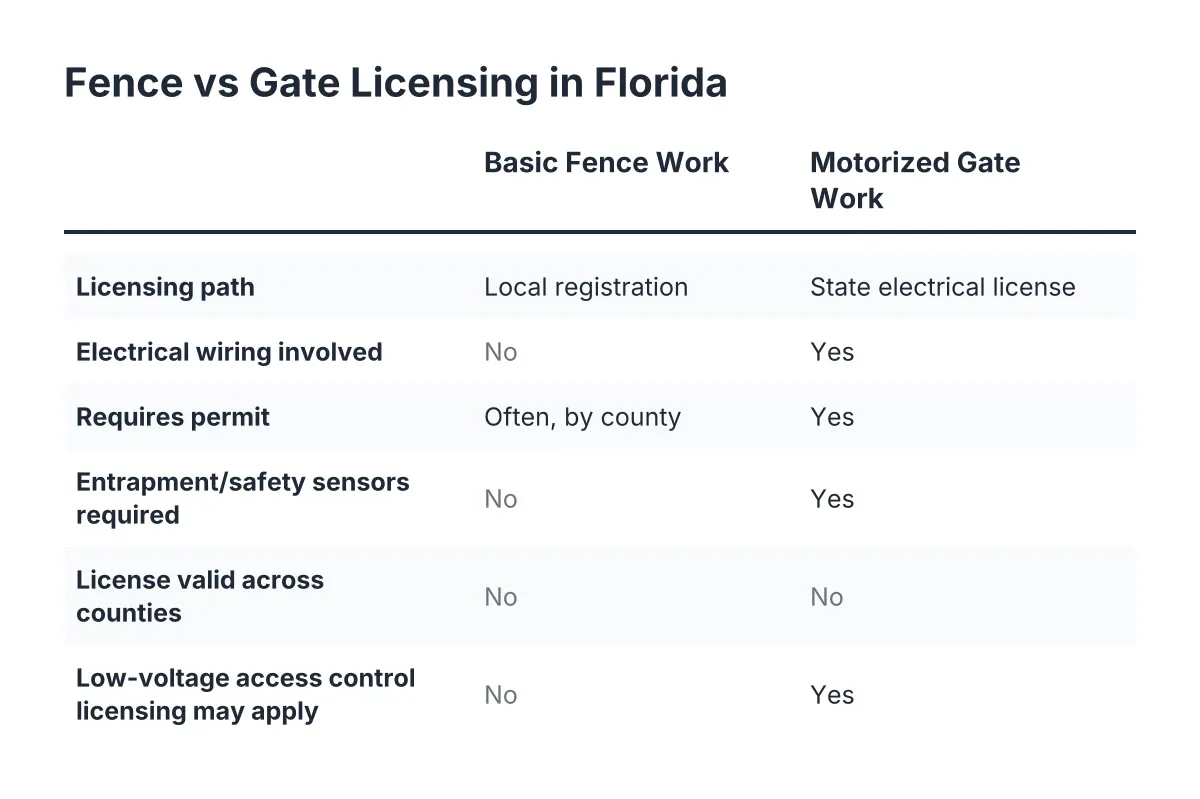
That difference changes the legal picture. In Florida, a basic fence installation is often treated as a limited scope of work. Many counties and municipalities handle fence contractors through local registration or a specialty license rather than a state license. Rules vary by county, which is part of why the question confuses people.
An electric gate is another matter. Once you add a motorized gate operator, you are dealing with low-voltage or line-voltage wiring, safety sensors, and entrapment protection. Electrical work in Florida generally requires a licensed electrical contractor or a properly licensed specialty contractor working within their scope. The gate opener itself must be installed to the manufacturer's specifications and to the safety standards that govern automated vehicular gates, which cover things like obstruction sensing and the reverse function that stops a gate from closing on a car or a person.
So when someone quotes you an automatic gate installation and shrugs off the licensing question, they are shrugging off the exact part of the job that carries the most risk.
Understanding Gate Installation Licensing Requirements in Florida
Florida splits contractor licensing into two broad paths. Understanding both helps you ask the right questions.
First, there are state-certified contractors. These are licensed through the Florida Department of Business and Professional Regulation, known as the DBPR. A state certification lets a contractor work anywhere in Florida within their licensed scope. General contractors, building contractors, and electrical contractors fall into this system.
Second, there are locally licensed or registered contractors. Many counties, including Manatee County, issue local specialty licenses for trades like fencing. A fence contractor registered locally can pull permits and work legally within that jurisdiction, but their authority does not automatically travel to another county.
Here is where gates complicate things. The gate installation licensing requirements that apply to a specific job depend on what the job includes:
- A manual swing gate hung on an existing fence usually falls under the same scope as fence work, handled locally in most jurisdictions.
- A new fence line with a gate typically needs whatever fence permit and local contractor registration your county requires.
- An automatic or electric gate adds electrical scope. The wiring portion generally needs to be done by, or under, a licensed electrical contractor, or by a specialty contractor whose license explicitly covers that work.
- Commercial gate systems with access control, keypads, and loop detectors can involve low-voltage licensing categories on top of everything else.
The practical takeaway is simple. Do not ask a contractor "are you licensed?" Ask "are you licensed for this specific work, in this county, including the electrical portion?" Those are three different questions, and plenty of installers can honestly answer yes to the first while quietly failing the other two.
Do Fence Installers Need to Be Licensed in Florida?
Fence installers in Florida generally need a local specialty license or registration in the county where they work, rather than a statewide license, though requirements vary by jurisdiction. Fencing is not one of the state-certified trades the way electrical or general contracting is. However, that does not mean anyone with a truck can legally install your fence.
Most counties in the Tampa Bay and Bradenton area require fence contractors to register, carry insurance, and pull permits for fence installation above certain heights or in certain zones. A contractor who cannot pull a permit in your county is telling you something about their standing there.
For property owners, the local nature of fence licensing creates a trap. An installer who works legally one county over may have no standing in Manatee County at all. If they install your fence without the required permit and the county flags it, the correction costs land on you, the owner, because it is your property and your permit record.
Fences also carry real code requirements here, even without a motor involved. Height limits, setbacks from the right of way, visibility triangles at driveway corners, and pool barrier rules all apply. In flood-prone parts of Bradenton, setback and drainage rules can affect where posts can legally go. A registered local contractor deals with these rules weekly. A handyman does not.
What Licensing Means Once the Gate Is Motorized
An automatic gate pulls your project into stricter territory, and this is the section to read twice if you are automating a driveway or securing a commercial lot.
The electrical scope
A motorized gate opener needs power. That might mean trenching line voltage from a panel out to the gate, or it might mean a low-voltage run from a transformer. Either way, electrical work in Florida is a licensed trade. An unlicensed installer who trenches power to your gate has created a code violation buried underground, where no one sees it until something fails or an inspector asks for documentation.
Solar powered gates for driveways change this picture in a useful way. Because the panel and battery live at the gate, there is often no long electrical run back to the building. For rural lots or long Bradenton driveways where trenching power would be the most expensive part of the job, solar can reduce both the cost and the electrical scope. It does not eliminate the need for proper installation, but it simplifies one of the hardest parts.
Safety standards and liability
Automated vehicular gates are governed by safety standards covering entrapment protection, which is the system of sensors and reversing functions that keep a gate from closing on a person or vehicle. A gate installed without proper entrapment protection is a known hazard. If that gate injures someone on a commercial property, the owner's liability exposure is serious, and "the installer seemed like a nice guy" is not a defense.
This is where the gate installation licensing requirements conversation stops being paperwork and starts being risk management. Licensed, insured contractors carry liability coverage and workers' compensation. If an unlicensed installer's helper gets hurt setting your gate posts, that claim can come looking for the property owner.
A commercial scenario worth thinking through
Suppose you own a small contractor yard in Bradenton. After a round of equipment theft in the area, your insurance carrier adds a requirement at renewal: perimeter chain link fence and controlled vehicle access at the entrance. You get three quotes for a sliding electric gate with a keypad.
The lowest quote comes from someone who will not name a license, will not pull a permit, and wants cash. In that scenario, say the gate goes in and works fine for a year. Then your carrier audits the security requirement and asks for the permit record and installer documentation. There is none. Now you are paying a second contractor to inspect, correct, and permit work you already paid for once. The cheap quote became the expensive one, which is the usual pattern with unlicensed work.
Permits for Gates and Fences Around Bradenton
Permits and licensing are related but separate. The license belongs to the contractor. The permit belongs to the project, and it attaches to your property record.
Do you need a permit to install a gate in Manatee County?
Most new fence and gate projects in Manatee County require a permit, and an automatic gate with electrical work almost always does. Requirements depend on the gate's height, location, and whether it includes a motorized operator. The safest move is to confirm with the county building department before work starts, because rules change and specific parcels can carry extra restrictions.
A few local factors regularly shape gate permits around Bradenton in 2026:
- Flood zones and setbacks. Low-lying parcels near the Manatee River and along the coast can have setback and elevation considerations that affect post placement.
- Right-of-way and visibility. A driveway gate cannot block sight lines at the street, and gates that open toward the road are usually restricted.
- Wind exposure. Storm-season wind loads influence post depth, footing size, and the gate materials that make sense here. In sandy soil, ground movement and settling are normal, so hardware placement and footing design need to anticipate shift over time.
- Pool barriers. If the fence or gate is part of a pool enclosure, Florida's pool safety rules add self-closing and self-latching requirements.
Homeowners' associations add a separate layer. HOA approval is not a permit, and a permit is not HOA approval. On a gated or deed-restricted property, you may need both.
Who pulls the permit matters
A licensed local contractor pulls the permit under their own license, schedules the inspections, and closes the permit out. When an installer asks you to pull an owner-builder permit instead, treat that as a red flag. Owner-builder permits exist for genuine do-it-yourself work. Using one to cover an unlicensed installer shifts the legal responsibility for the work onto you, which is exactly what the installer wants and exactly what you do not.
How to Verify a Gate Contractor Before You Sign
Checking a contractor's standing takes less time than reading their quote. Here is a practical sequence any Bradenton property owner can run in an afternoon:
- Ask for the license or registration name and number, then look it up. State-certified contractors appear in the DBPR's online license search. Locally registered fence contractors can be verified through the Manatee County licensing office.
- Confirm the scope matches the job. A fence registration does not cover electrical work. Ask who handles the power run for the gate opener and what license that person holds.
- Ask for proof of insurance. General liability and workers' compensation certificates should come from the insurer, not as a screenshot from the contractor's phone.
- Ask who pulls the permit. The right answer is "we do, under our license." A pause, a discount for skipping it, or a suggestion that you pull an owner-builder permit are all warnings.
- Ask what safety devices the automatic gate includes. A competent gate installer will talk about entrapment protection, obstruction sensing, and reverse function without being prompted.
- Get the scope in writing. Post depth, footing details, operator model, electrical responsibility, and permit responsibility should all appear on the proposal.
None of this is adversarial. Legitimate contractors answer these questions every week and expect them. The installers who get defensive are the ones the questions are designed to filter out.
Where Licensing Fits in the Bigger Gate Decision
Licensing is a threshold question, not the whole decision. Once a contractor clears it, you still have the real choices in front of you: swing versus slide, steel versus aluminum frame, keypad versus remote versus phone-based access, and whether your existing gate can take an opener or needs replacement. Gate installation on an existing fence line also raises structural questions, because the posts that held a manual gate may not be stout enough to carry an operator and the forces it applies thousands of times a year.
There are also honest limits to what any article can settle. Licensing categories, permit thresholds, and code requirements vary between counties and change over time, and a specific parcel can carry restrictions a general guide cannot predict. For anything involving electrical work, flood-zone setbacks, or a commercial insurance requirement, confirm the current rules with the Manatee County building department or a licensed local contractor before money changes hands.
The pattern worth remembering is the one that runs through this whole topic. The cheapest quote on a gate is cheap because something is missing, and the missing piece is usually licensing, insurance, permits, or safety equipment. Those are the parts you cannot see in photos of finished work. A properly licensed, permitted automatic gate costs more upfront. However, it is the version that still works after a storm season, passes an insurance audit, and does not turn into a legal problem buried in your yard.
If you are weighing contractors for gates and fences in the Bradenton area right now, start with the verification checklist above. Fifteen minutes of license lookups will tell you more about an installer than an hour of sales conversation.
If you need automatic gate installation, Manatee Fence Co can help.
Prefer to talk it through? Call (941) 219-6611 — a quick call is usually the fastest way to get a straight answer for your situation.