Repair or Replace Your Aging Fence? A Step-by-Step Guide for Sarasota and Bradenton
If your fence is leaning, sagging, or missing boards, you face one question: fix it or start over? Searches for Sarasota fence repair spike after every storm season, and most of those callers are asking the same thing. The honest answer depends on the posts, the material, and how much of the fence has failed, not on a sales pitch. This guide walks you through the decision step by step, whether you manage a commercial lot with a chain link perimeter or you are a homeowner racing a pool inspection deadline.
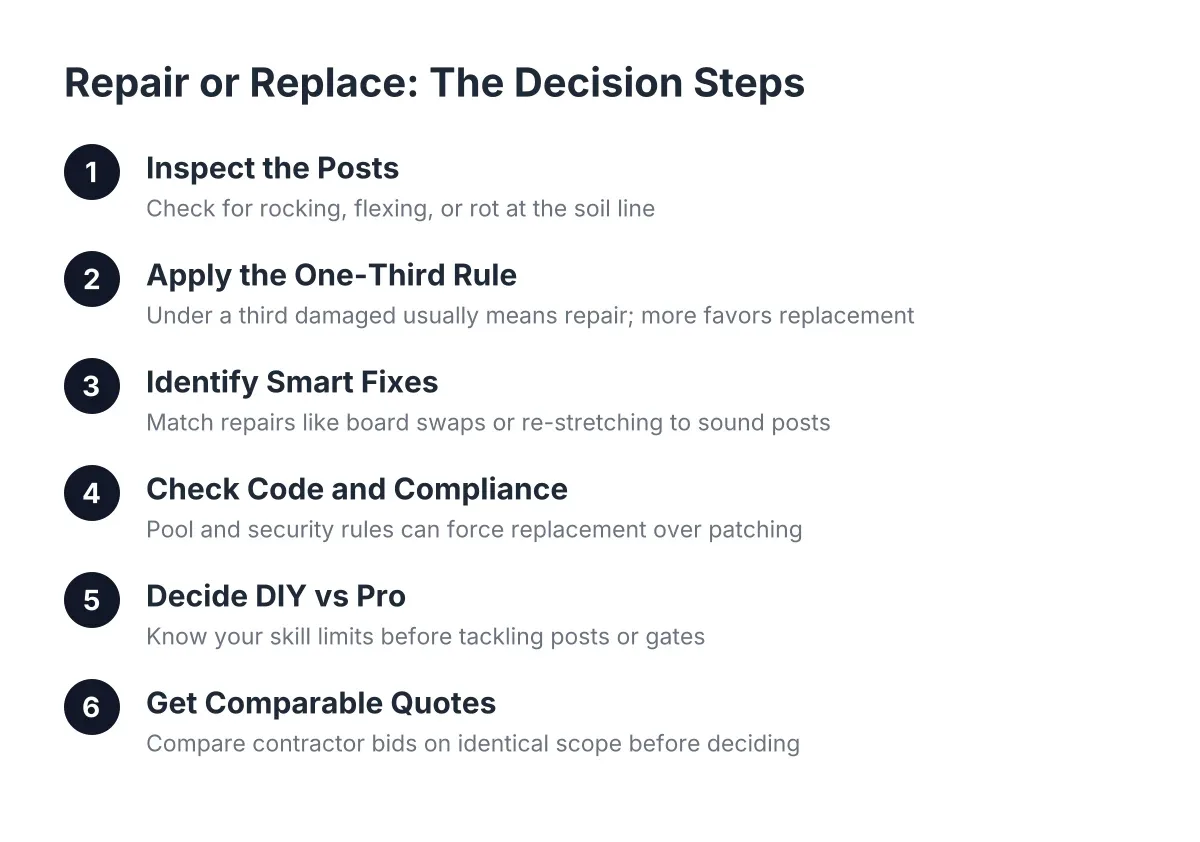
Work through the steps in order. By the end, you will know whether a fence repair, a partial rebuild, or a full fence replacement makes the most sense, and what to ask a contractor before you sign anything.
Step 1: Inspect the Posts Before Anything Else
Posts decide everything. Panels, pickets, and chain link fabric are all replaceable at reasonable cost. Posts set in concrete are not. If the posts are solid, you are probably looking at a repair. If several posts have failed, replacement starts to win.
Grab each post and push hard in both directions. A solid post barely moves. A post that rocks in its footing, or flexes at ground level, has a problem below the surface.
For wood fencing, check right at the soil line. Wood posts commonly rot at ground level even when the panels above look fine and have been repainted for years. Probe the base with a screwdriver. Soft, spongy wood means the post is failing no matter how good the fence looks from the sidewalk.
For chain link, look at the posts and rails, not just the fabric. Bent top rails and leaning terminal posts matter more than a sagging section of mesh. A commercial lot with straight posts and loose fabric usually needs chain link fence repair, not a new fence.
Step 2: Count the Damage and Apply the One-Third Rule
Walk the full fence line with a notepad. Mark every failed post, every broken or missing board, every rusted-through section, and every gate that drags or will not latch. Then step back and look at the totals.
A rough rule of thumb many contractors use: if less than about a third of the fence has problems, repair usually makes sense. If damage runs past a third, or if failures are spread along the whole line rather than clustered in one spot, replacement often costs less over time than chasing repairs section by section.
Also weigh the age and material:
- Wood fencing in Bradenton's sun and humidity has a shorter working life than vinyl or chain link. An older wood fence with scattered rot is usually telling you it is near the end.
- A vinyl fence or PVC fence with one cracked panel from a mower strike is a clear repair. Widespread brittleness or UV chalking across many panels points toward replacement.
- Chain link lasts a long time here if the galvanizing holds. Isolated fabric damage is repairable; widespread rust at the base of every post is not worth fighting.
One caution on the cheap route. Patching a fence that is structurally done often costs more over two or three years than replacing it once. Price reflects construction quality and expected lifespan, not just boards and labor, so a string of small repairs on a dying fence is money you never get back.
Step 3: Sarasota Fence Repair: Smart Fixes and When to Replace
Some repairs are smart money, and some are throwing good money after bad. Knowing the difference is most of the game in Sarasota fence repair, because sandy soil, a high water table, and storm wind create failure patterns you may not see in other regions.
Repairs that usually pay off:
- Replacing individual boards or pickets on a wood fence with solid posts
- Re-stretching or patching chain link fabric where posts and rails are straight
- Swapping a cracked vinyl panel or rail into existing sound posts
- Rehanging a sagging gate, or upgrading hinges and latches
- Resetting one or two leaning posts after a storm
There is also a middle path worth knowing about. When a wood post rots at ground level but the concrete footing is intact, a crew can cut the post above the rot and set a steel post into the original footing. That costs less than digging out the old concrete, and it stiffens the fence considerably. For an aging fence you plan to replace in a few years, this kind of interim repair keeps it standing without wasting the money; the work effectively bridges you to a planned fence replacement instead of forcing an emergency one.
Repairs that rarely pay off: replacing panels on a line of rotting posts, repainting a wood fence whose structure has failed, and patching the same gate every few months instead of fixing the posts that hold it.
Step 4: Factor In Code, Compliance, and Security Requirements
Sometimes the fence's condition is not the deciding factor. The rules are.
Suppose a Bradenton homeowner just finished a pool and the inspector flags the old fence: gaps too wide, height short in one run, and a gate that neither self-closes nor self-latches. In that scenario, patching the worst sections rarely gets the enclosure to pass. A compliant barrier needs consistent height, controlled gap spacing, and self-closing, self-latching gate hardware along the entire pool side. Replacing that run, rather than repairing it piecemeal, is usually the faster path to a passed inspection, and insurance requirements often push the same direction.
Commercial properties face a parallel question. Say a property manager has had two break-ins through a sagging chain link corner. Repairing the cut fabric fixes the symptom. Replacing that run with taller commercial-grade chain link, adding a motorized gate with access control, and securing the bottom edge fixes the problem. If a lease renewal requires security upgrades, document the fence condition with photos; that record helps justify the spend to ownership and makes it easier to compare quotes on equal scope.
If you are unsure whether your situation triggers a permit or a pool-barrier requirement, talk to a licensed contractor or your local building department before you commit either way. Code questions are not a good place to guess.
Step 5: Decide What You Can Do Yourself and When to Call a Pro
Plenty of fence work is within reach for a capable owner. Knowing how to repair a fence at the small scale saves real money.
Reasonable DIY tasks:
- Replacing a few wood boards or pickets on sound rails
- Tightening chain link fittings and tension bands
- Adjusting gate hinges and latch alignment
- Cleaning and staining wood fencing; staining both sides extends its life, not just its looks
Call a professional when the job involves setting or resetting posts, replacing full sections, pool-barrier compliance, or any electric gate or automatic gate work. Post work in Bradenton's sandy, low-lying soil is less forgiving than it looks; set a post shallow or with a weak footing and the next tropical system will find it. Gate operators add electrical and safety considerations that belong with gate installation services, not a weekend project.
Searching for chain link fence repair near me or a metal fence company near me will surface plenty of options. The next step tells you how to sort them.
Step 6: Get Quotes That Compare the Same Scope
Whether you land on repair or replacement, get at least two or three written quotes, and make sure each one prices the same work. A fence company quoting a full tear-out against another quoting post-preserving repairs is not a fair comparison, and the cheapest number on paper often hides the shortest lifespan.
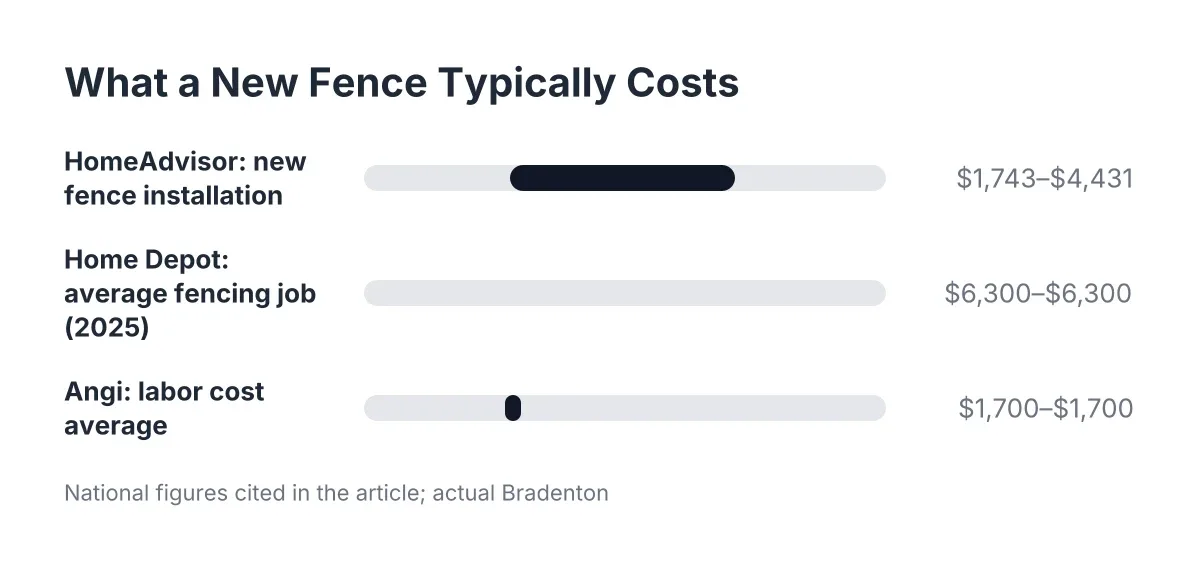
For context on replacement budgets, HomeAdvisor data shows homeowners spend between $1,743 and $4,431 for a new fence installation, averaging $3,059 nationally, and most pay about $23 per linear foot for professional installation and materials. The Home Depot puts the average fencing job in 2025 at $6,300. Your number depends on material, length, terrain, and gate count, so treat these as orientation, not a promise.
Ask every bidder three questions:
- What condition are the posts in, and does your price include post work or just panels?
- What is included, and what is extra? Old fence haul-away, permit handling, and gate hardware are common add-ons.
- How will this material and build style hold up to our sun, humidity, and storm wind over the next ten years?
A fair quote spells out material grade, post type and footing depth, linear footage, gate hardware, cleanup, and timeline in writing. Timelines vary with permits and material availability; straightforward repairs often take a day or less, while full replacements run longer. For a commercial lot, ask how the crew will phase work so the property stays secured overnight during the fence installation.
Step 7: Make the Call and Line Up the Timeline
Pull your notes together. Solid posts and localized damage, repair. Widespread post failure, code problems, or a fence past its expected life, replace. A structurally sound fence that falls short of pool code, replace the non-compliant runs and upgrade the gate hardware.
In addition, plan around the calendar. If a pool inspection or lease deadline is driving the project, tell your contractor up front so permits and materials get ordered in the right sequence. As of 2026, storm season still concentrates repair demand in late summer and fall across the Bradenton and Sarasota area, so booking fence repair or replacement ahead of that window means shorter waits.
Manatee Fence Co handles wood, vinyl, and chain link fence repair and replacement, along with automatic gate installation, for homeowners and businesses serving Bradenton and the surrounding area. If you have walked your fence line and still are not sure which way to go, reach out for a fence estimate. We will look at the posts first, explain the cost factors in plain language, and tell you honestly whether repair or replacement is the better use of your money.
If you need fence repair, Manatee Fence Co can help.
Prefer to talk it through? Call (941) 219-6611 — a quick call is usually the fastest way to get a straight answer for your situation.